Of course, I don't really care much how writers resolve the AAA bond bind, but I find it interesting and am now reminded of a truly fascinating article from the Wall Street Journal that was sent to me the other day: "Lost in Translation". The article reports on recent research that demonstrates how language actually determines culture, perhaps to an extent we could not have imagined. I learned that many languages do not have the concept of "left and right". Rather, they use the cardinal points for this kind of lateral orientation, even for the body. And, experiments have shown that people in cultures whose languages do this tend to have better spatial orientation. That is, they have "a great sense of direction." Learning another language can expand our horizons. The metaphor is perhaps more appropriate than we had imagined.
Showing posts with label Translation(s). Show all posts
8.02.2010
Language Minutiae
6.08.2009
Tourists?
Reading José Angel Cilleruelo's blog El Visir de Abisinia is always a pleasure and it never fails to offer the reader fresh surprises. There are often little jewels. In a recent entry José Angel, who lives in Barcelona, makes a very interesting observation about the nature of tourism. Here's a spontaneous translation:Tourists
I sit in Holy Family Square and watch the tourists go by. Just as they happily contemplate the city of monuments and its beauties, I admire the passion of the traveling couple, the friendship of the groups of friends, the family spirit of the families. Neither they nor I participate in an illusion. The naivety that surrounds tourism is an important path to happiness: belief that the world is well made* somewhere else. What they do not know about us –what I do not know about them– makes it possible to perceive only that which is pleasing. Which also exists.
*The world is well made: "El mundo está bien hecho." A famous line, often poorly interpreted, from a poem by Jorge Guillén, a famous XX century Spanish poet.
In any case, a tourist makes for a rich metaphor. When we get back to Carlisle, I want to be like a tourist, to see anew. And I'll need to do this translation anew. After all, José Angel has been cultivating for over a couple of years now this particular textual form, which is defined by the text having exactly one hundred words. Form and content. Oh, a slow start to the week: I haven't got either just right yet. (A little later: I still don't have it right, but I did get my translation into a one hundred word block. So, back to the Modernists: Make it new! (In the photo, a couple of happy tourists in Nerja.)
2.18.2009
Walt Whitman
1.26.2009
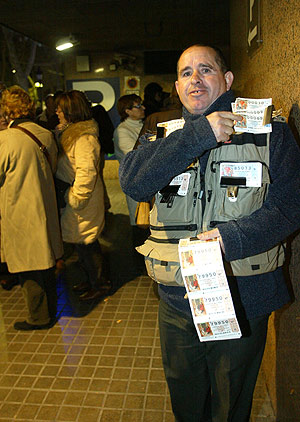
Birth by Chance
–Please, could you give me a number that ends in 85.
–Does it have to be 85?
–Yes, it's got to end in 85.
–85, let's see what I can find. Here's one in 58 that smells like a winner. Will it do?
–How funny. I was born that year. In 58.
–A good reason.
–I'd prefer one that ends in 85.
–That means your reason is better.
–Well, perhaps.
–A reason better than having been born? Could there be one?
–I don't think so, none.
–So? 58?
–So: 85!
–Better than being born?
–To be born again.
–Another time?
–Not another time, the first time.
–Now I get it! But in 85... Nothing!
And speaking of birth, how about that woman in California and her eight newborns! That's hitting the lottery! I'm hoping not to be unborn today. Have a little trip to Cordoba to see Pablo today; should be fun.
10.15.2008
Searching
I search for myself in time badly spent
and in calendars whose pages are old,
but the scent of my soul has gone cold,
and the old man I knew he up and went.
The one I was just a one time event?
I want news of myself, news to unfold
the layers of myself, these words of gold
to relieve oblivion, my one lament.
The small adventure of this boat that sails
blue seas and feels the force of big strong gales:
yet no mermaid with any answer sings.
My wine and questions are in the same cup.
Pains and doubts. Everything piles up.
And God's answer is to not say a thing.
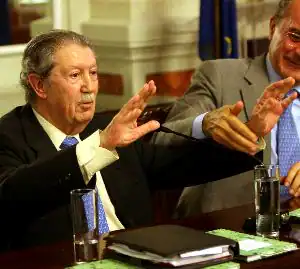
We're all searching. The Red Sox too. They just got beat badly again. The lost autumn of Big Papi? He's got one more chance to find it. They all do. I hope today isn't my last chance. I don't think it will be. (First I've got to figure out the 'it' I'm supposed to be looking for; actually this life as search idea isn't really my cup of tea. I just keep rooting for extra innings, endless, infinite extra innings. And it's softball, none of this three strikes and you're out nonsense. Damn, with those rules I'd have been gone long, long ago.) We had a funny family meeting last night: Asun and I here in Malaga video talking to Alma and Cristina, who were rather comically seated in one of the little campus information booths where Alma sometimes works, and Daniela in Madrid participating via speaker phone. A couple of times we had to stop so Alma could give directions to campus visitors. And at times there were several conversations going on at once: travel plans, help with homework, just catching up, boyfriends, etc. Today's word is: Discombobulated. (In the photo, Manuel Alcántara.)
Labels:
Baseball,
Daily Routine,
Readings,
Translation(s)
6.01.2008
Two languages. Two me's?

Yesterday I was reading the paper and was sur- prised (and somewhat flattered) to see myself quoted in Pedro Aparicio's weekly article. He was discussing J. Soto's new collection of poetry and quoted the review I wrote for El Mundo. In any case, he seemed to like my description of one of the book's qualities as an espejismo vital. When I wrote that I new exactly what I was referring to and precisely what I meant to say. But a few minutes after reading Pedro's article I fund myself thinking in English. It occurred to me that I would be at a loss to express that same concept in English. A lively mirage? It doesn't sound right at all. I guess I could use a good bit of circumlocution and describe what I meant, but that wouldn't do very well. Just one little example of why translating one brief poem can take so darn long. (And this example doesn't even take into account all the attention that must be given to questions of rhythm, sometimes of rhyme and meter, metaphor, etc.) Do I think differently in Spanish than in English? No doubt there are some differences, since we think verbally. So when I'm thinking in Spanish I'm drawing on the Spanish dictionary in my brain, in many ways poorer than my English dictionary, but in some ways richer. And going back and forth, that is, drawing on both dictionaries simultaneously, is not as easy as it may seem. I do that some, of course, but it's a process that slows down my thinking and can often be an unwelcome interference. (OK, another off the cuff gloss of that expression: organic self-deceptions/revelations; not that it sounds much better, but to some degree it gets at what I was referring to: the poet's unavoidable tendency to express feelings and desires that he knows are partially artifice, yet are rhetorically necessary steps on the path to his poetic truth.) Perhaps the photo does a better job of exemplifying how a creative fiction can suggest a profound truth. This bronze in the center of Malaga is a homage to Rafael Pérez Estrada and it's based on one of his wonderful ink drawings. This imaginative hybrid ("Ave quiromántica") suggests many things; among them, peace, liberty, and friendship. So I guess looking for me in two different languages is fun. But maybe, after all is said and done, certain qualities of silence will turn out to be the most fruitful path.
Subscribe to:
Posts (Atom)