Showing posts with label Vida malagueña. Show all posts

6.07.2009

A Day in the Country


Yesterday we enjoyed a beautiful afternoon out in the country, back at Rosalind and Chris's place up behind Frigiliana. It was yingyangy weather –hot when the sun came out, chilly when the clouds passed over. Rosalind made another very nice paella. We brought some boquerones (anchovies) that I had prepared on Friday: cured in vinegar and lemon juice for twelve hours, then drained and covered in olive oil with some salt, garlic, and parsley. (See top photo.) Very good! What a wonderful spot: quiet, spectacular views, an unbeatable climate. Enviable. Photos are better for this.

5.05.2009

Book Fair

This week Malaga is celebrating its annual Feria del Libro. The stands are all set up on the Paseo del Parque and the week is full of book signings, presentations, conferences etc. Last night novelists Clara Sánchez and Rafael Chirbes joined Soler for a round table session on the generic topic of Novela y creación.  It was an interesting event, but not especially substantive. The discussion was moderated by Pablo Aranda. I'm trying to come up with some memorable comment, but I keep drawing blanks. (Reminder for me: afterwards we walked Isabel part way home then stopped by the Plaza de la Marina with Arcas to get something to eat at the Feria Intercultural they've got set up there. We chose the Puerto Rico stand, but actually the women there were Cuban. They were very nice and we had an interesting conversation with them as we ate some decidely mediocre food.) Speaking of books, right now I'm reading Javier Cercas' Anatomía de un instante, an in-depth look at the failed coup attempt of 1981, known here simply as "23-F", for the date: February 23rd.  It's an excellent book, truly fascinating. I haven't been keeping up with taking note of current reading. Oh well. (Red Sox just beat the Yanks in NY. That makes them 4-0 against the bombers so far this year.) In the photo, the Paseo del Parque with the stalls set up for the book fair.

4.28.2009

European Identity

Yesterday former mayor and Europarliamentarian Pedro Aparicio came to talk to my students. Pedro was mayor from 1979 to 1995 and played a fundamental role in transforming Málaga into the modern city it is today. He is widely admired for his integrity and dedication. And better yet, he is gracious, charming, and always willing to be helpful. (See 4/2/08 entry.) I was supposed to participate with him in a round table session dedicated to the Biblioteca de Autores Malagueños, but am going to have to miss it because I had already committed to going to Madrid for an APUNE meeting. In any case, he addressed the topic of European identity-its possibilities, limitations, etc. It was a great honor to have Pedro with us and he gave an excellent, informative lecture. (One of his better lines, that I fear left the students rather perplexed, was "Europe is Kant.") It's clear that Pedro has become rather pessimistic regarding the "construction of Europe" and the referendum defeat in France on the European Constitution was a great disappointment to him. A few of the students had some excellent questions at the end of the lecture and their contributions were quite gratifying. Afterwards Asun, Pedro and I headed back to the Malagueta to meet with Juvenal and his friends at the Maestranza prior to the presentation of Juvenal's Compañeros de viaje. That presentation went nicely and was well attended. Juvenal read several sonnets, including one he dedicated to me.

4.10.2009

No Words...

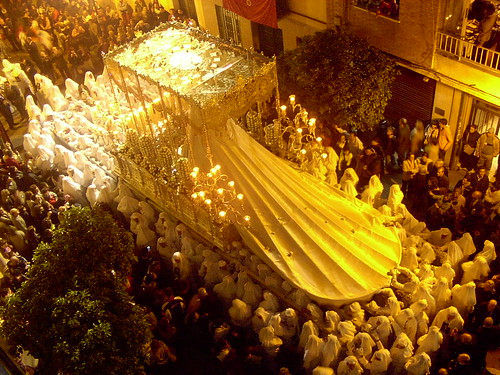
Could possibly describe adequately what it was like Tuesday night. Certainly not how it felt. Soler had asked me about my possible interest in "going into the submarine" in the Virgen del Rocío procession, but as these things don't always work out I remained a little skeptical. Besides, I know what a big deal it is for the men who carry the throne, and I really didn't want to be putting anyone out, even if just for a couple of minutes. So with these reservations in mind, we met in the Plaza de la Merced at 9 and the scene there was already crazy. The idea was that Antonio and I would go into the submarine when Rocío got to Calle Alamos. It looked like that was about an hour away, as the processions were already getting backed up. Clarification: the "submarino" refers to the space directly beneath the throne. Most don't have people in there, but some of the bigger ones do, including Rocío. (See photo, which I believe is taken from Calle Victoria.) So instead of just standing around we (Asun, Daniela and me; Antonio, María del Mar, Fernando, and Agustín Rivera) went to get a bite to eat on one of the side streets off the square. I couldn't eat. I wanted to get going. Finally, around 10:30 we went off in search of Rocío. The procession had moved down Calle Alamos and was at the beginning of Calle Carretería, Rocío's street! Complete madness, you could hardly move, but we managed to eventually squeeze our way through and reached the throne in pretty good time. I thought Antonio would have to get out his cell phone, call, wait, etc., but no, all of a sudden I see him disappear underneath the throne, so I just followed him. Complete darkness and I hear a couple of guys saying to me watch your head, watch your head. Slowly my eyes adjust. But there's no time: cling, cling, goes the bell and everyone's scrambling to take position. So I grab the post I've got next to me, cling!, upphh, lift, and just like that, I can NOT believe this, I'm in the submarine helping to carry THE throne, down THE street. The darkness really distorts my sense of time and space and for the first 30 seconds or so I'm feeling a little nervous, and as a result I can't seem to get in step. This is essential, because there's only a few inches between the guys in front of and behind you. It's really tight. The guy in front of me feels my right foot bang into him a couple of times and I'm certain as soon as we stop he's going to demand that I be thrown out. We move forward a little, cling!, down comes the throne. Rest. The fellow in front of me smiles and welcomes me warmly. A few seconds to say hello, thank everyone profusely for allowing me to be here, but... cling, cling!, Cling! Uppphhhh, lift that throne, steady, sway a little, a few steps back, now forward... beautiful. You can hear the crowd responding. Now I'm focused on the band right behind us and the big drum is marking the beat. Ah ha! Now it's easy, left, always lead with the left I remember Agustín telling me. So with the beat of the drum and watching the feet of the men to my right, I fall into the rhythm. Rest. Alvaro, the guy who seems to be in charge of this group of thirty or so "invisible" hombres de trono, offers encouragement and brief words of advice. Water is offered, and I'm given a handful of little photos of Rocío. Cling, cling... off we go. Someone (Alvaro?) is reciting over the top verses of praise to Rocío. Poetry! The most beautiful.., a drop of divine dew... balm for our tired shoulders... I don't think I've ever experienced anything remotely as absurd, crazy, surreal, and simultaneously wonderful and civilized. I really feel like I'm in a dream, because surely these things don't happen in real life. More encouragement: hold her steady, she's the bride... so smooth not a single candle will go out... And the constant screaming from the street: guapa!, guapa! Ro-ciií-o!! Ro-ciií-o!! Two hundred and forty men to lift this thing. Ten thousand, twenty thousand, it seems like a million people surrounding the throne. It's hot in the submarine and quickly I break into a sweat. And the others in here have already been at it for over three hours. They've got six or seven hours to go! In one stop we move around a little and I go back to the rear right corner where there's a little more room. After a while I sense that we're getting near the Tribuna de los Pobres. This is the famous curve where people have been waiting and waiting, in some cases for hours. And it's here where one of the best saeteros is always positioned, ready to belt out this particular variant of cante jondo, the "deep song". This is where the cheering gets really wild and the throne gets lifted a pulso. Antonio had already asked me if I'd had enough. Are you crazy? As soon as I realized that no one was kicking us out, that in fact there was space for us, I thought, hey, let's keep going all the way to the Tribuna. In the next stop, Alvaro quiets everyone down: pay attention, this is it, this is big... it gets really loud, listen carefully, it will be very hard to hear the bell... I can barely see anything outside the submarine, but I know what it's like. The energy on the street is palpable and the the band is playing as loud as they can, trying to stay audible. We're getting close. "Guapa, guapa, guapa!" Stop. It gets quiet. A saeta. Bone chilling. The saetera is just to our left, above us. She has a beautiful voice. Are we in Morroco?, Arabia? Malaga in the twelth century? Or is it Woodstock? Ayyy, ayyy, ay yaaaay yaaaaayyy..... The timing is perfect. Among the seeming chaos and anarchy someone is thinking of the choreography. A little ways into the saeta, cling!, we lift: Rocío comes to life, the Virgin likes the praise. We gently sway the throne. This is beyond fun! Then, as we move the throne forward, a wailing lament, the reluctant goodbye that has turned my whole being into one big goose bump. Huge, huge applause. We're here. Tribuna de los pobres, the main stage! It's also beyond strange to me, I'm invisible but at the same time I'm quite literally at the very center of the spectacle, right beneath the Virgin, underneath the star. Beautiful! Some of the earlier rests were coming at intervals of less than a minute, but there are no rests here. Ten minutes straight. Maneuver that throne. "Viva la Novia de Málaga! VIVA!!!" There's no space, like parallel parking an eighteen wheeler in an aisle in Fenway Park during a game seven. (And imagining that, if you can, as the whole point of everyone's being there!) But it works, slowly, step left, step left, forward... back.. forward...Uppfff. "¿Qué se le dice a la Virgen? GUAPA!!!" Both arms extended. We lift, from shoulder to finger tips. She's as high as she can go. Delirium! Down. Up again! Greet your audience, take a bow. More lifts. I lost count. Four? Five times? RO-CIII-O!!! RO-CIII-O!!! (Watch this youtube video: http://www.youtube.com/watch?v=G6Q0Ruv2yD4  to get a sense of what it was like. It transmits some of the sense of excitment.) And I cannot believe it. How did I end up here? When I was sixteen I got to play a basketball game in Boston Garden. Huge! This was bigger, much bigger. Ten times huger! Someone wake me up.

4.08.2009

Later Monday

So I'll start with the surface, the exterior, jotting down here lots of details for the sake of my own memory, because I want to have the details on record. I don't want to forget anything. Some further notes on the rest of Monday: after the early morning session to see the Cautivo, Asun and I did what we could to have some semblance of a normal day back at the apartment. I got a little work done, we had lunch, etc. We took a brief nap. In the evening we went downtown and saw a couple of processions. First we saw the Virgin that accompanies Crucificción go into the cathedral. Nice. Then, thinking that procession was due to make its way across Calle San Agustín after it exited the cathedral, we got a nice table on the terrace at Restaurante Tormes: perfect. Owner Pepe came over to chat and to reassure us that everything on the menu was good to go. But we didn't want a real dinner, just something light. So we have some wonderful ham and a good ensalada malagueña that has a wonderful little detail: some very fresh dill sprinkled on it. What a combination: just the right touch of cod, beautifully cured olives, super fresh slices of orange, the potato... all of which have been lightly blessed with good oil, and then the dill. Olé! Just as we're finishing our salad, here comes the procession. Our own baroque dinner theatre in an unbeatable little corner of Malaga, sitting right in the shadow of the sixteenth century Palacio Buenavista, now home to the Picasso Museum. But wait, the procession is turning left, there they go, down Calle Echegaray. Oh well. So it didn't come right by us, which would have been a lot of fun. We aren't the only ones fooled: Pepe thought they were coming our way and lots of others too–the terrace is packed. But the night is yet young and there are several processions winding their way through the city: next stop, Gitanos, which we see in the Plaza de la Merced: the Cristo de la Columna together with María Santísima de la O. It's interesting to see how the Christ throne takes the long way around the sqaure, the Virgin throne takes the short cut, and that way they can "meet up" at the corner where Picasso's birthplace is. How's that for a estampa malagueña? Each throne involves several hundred people, and the procession as a whole has at least a thousand direct participants. And a good ten thousand people filling the square. Overall a scene of relaxed anarchy with a parade slowly marching through it. And here we get the full effect of the "dolls for grown ups" phenomenon. I just love seeing how the portadores create a sense of theater in the way they "sway" the thrones. First, the operation of getting the thrones to face one another. Quite reminiscent of watching a cruise ship trying to dock. It takes time. OK, now Jesus is facing Mary. The thrones are lifted a pulso, arms fully extended. Well done! Wow! The crowd loves it."Oh my son, are you OK?" "I'll be fine, these Romans have got it in for me, but don't you worry..." Great theater! I'm sure many might take this as a rather blasphemous reading of what's going on, but that's not my intention by any means. There's something about it that reminds me of ballet. There's music, incredible costuming, movement, a simple story line...  a collective, complicated effort to produce an effect of great beauty. But at the same time there is the tremendous absurdity of it: what's with hundreds of men, with hundreds more in tow, lugging around a platform that weighs tons (literally) for eight or ten hours? Of course, for Christians who are accustomed to living Holy Week as a time of deep reflection, of quiet meditation on the passion of Jesus, Malaga in general may seem like a place to be completely avoided. Surely no church in its right mind could condone this. (This is not religion, it's idolatry, paganism!) I have a catholic friend who feels this way: this is not catholicism, this is not what we teach! And we have completely secular, non-believer friends who also skip town this week, who find the whole spectacle ridiculous, somewhat abominable, and perhaps even slightly embarrassing. So where are we? That's a question we're not going to be able to answer. It's beyond our scope. I guess you could just call it popular religion, and many do describe it in those terms. In any case, after Gitanos, we walked down to the Alameda to catch a glimpse of the Cautivo. Huge crowds. We caught the very end of another "meeting", this time between two different processions: the Virgin that accompanies Estudiantes greeting El Cautivo as it approached the Alameda from a little side street. A distance greeting. And that was it for us. We were tired and it was almost midnight. El Cautivo would be parading around until five am or so, but that wasn't for us. That was Monday. In the photo, Sentencia, in its traslado, going by the spot on Calle Granada right where Asun and I were enjoying some wonderful food. For the real procession she's on a much, much bigger throne. Restaurante Tormes is on the left and the tables are on the right. (To be continued...)

4.02.2009

With Bipolar Lenses...


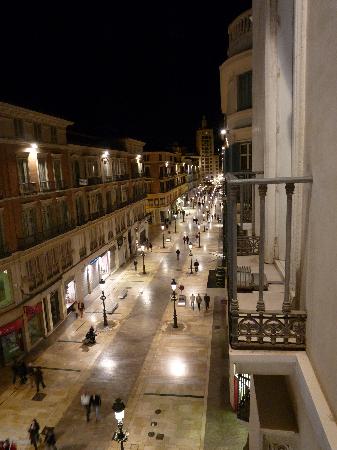
Good day, bad day. Order, chaos. It seems that so much of our contemporary reality is interpreted as a constant back and forth movement. Riding the yo-yo. Stocks are up. No, they're down. The world is falling apart. Wait, things are getting better. Life in Malaga certainly lends itself to this kind of bipolar reading. There's a forward looking lense in which you can see a prosperous, technologically advanced, cosmopolitan, multicultural city. Turn around: what were we thinking? Poverty is everywhere, nothing works, backwardness and provinciality rule supreme. Calle Larios vs. Calle Beatas. The other day, as is often the case, the beach right here out front was really dirty and the Paseo Maritimo a stinking mess. Then the limpieza army sweeps through, the sun comes out and it's back to Paradise. It never lasts long: it just takes a handful of the regular slobs to mess it all up again. It's amazing how groups of beach goers refuse to make even a minimal effort to clean up after themselves. Some days everything works smoothly: you get to the bus stop right before the bus arrives. The driver greets you kindly. You go to the bank and there's barely a line. Then, the next day Malaga presents itself as a paradigm of incivility and disfunction. This week there is frenetic activity to get the city all spruced up for Holy Week. This is Malaga's big show! Too bad it can't be the week before holy week all the time. The Paseo Maritimo has been power washed, the gardeners have come through and cleaned up the flower beds and cut the grass. Our little neighborhood is looking quite splendid right now. Rest assured they don't do it for us. If the city weren't expecting a huge influx of tourists, forget about it. (In the top photo, Calle Larios at night; below, Calle Beatas, in the heart of downtown.)

3.08.2009

Noise!

Sunday morning, 9:30 am. They're getting ready for a running race in support of breast cancer research and they've got the start and finish set up right beneath the apartment. The noise is incredible. Why do Spaniards insist on accompanying these kinds of events with sound systems appropriate for stadium concerts? I'm all in favor of supporting cancer research, of course, but couldn't they skip the screeching music and obnoxious mc's? It's really too bad, because this huge crowd of women pumped up to run is a wonderful sight. What a shame that the organizers are ruining the morning for a whole neighborhood and to no purpose except that of perpetuating a national ill: the idea that if it makes a lot of noise it must be important. Unbelievable. Ok, so now the women have gone off running, few people are left, but the jerk with the microphone won't let up. I'm getting out of here–there's no fighting it. Well, at least it's a beautiful day. This is more like it. Hopefully winter is really gone now. On Friday I took Adrienne Su, her daughters and her mother to Granada. It rained and was rather chilly up at the Alhambra. They are in Seville today and will be back in Malaga tonight. 

2.28.2009

The 300 Year Old Stereotype

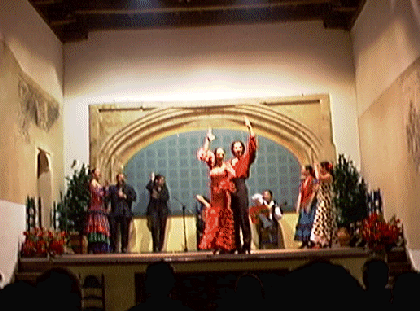
Today we celebrate a product of the Spain of the Autonomies: "Día de Andalucía", designed to foment regional identity. There'll probably be lots of folklore on the streets. This morning Pedro Aparicio writes in Sur about the city's newest trick for trying to suck more money out of the cruise ship tourists: morning flamenco shows in the Teatro Cervantes. Olé! You'd think that in the XXI century we'd about had enough of playing to tired stereotypes. This is how Malaga is going to compete for the European Capital of Culture designation? Good luck! Pedro's indignation is understandable. After all, as mayor he was the driving force behind getting the Cervantes renovated, creating a truly professional orchestra to play there, bringing Opera to the city and generally speaking promoting a cultural life that until then had been famous for its absence. This is not about being anti-flamenco in any way or even having a snobbish attitude about culture. And ask anyone involved in the world of verdiales, that ancient music from the hills behind the city, who was most important in its revival and chances are they'll tell you it was don Pedro Aparicio. Yes, of course flamenco is relevant and there is in fact a vibrant and evolving flamenco scene that has a devoted audience. But the current managers of the Cervantes seem to have old models in mind. The "package" they hope to sell to tourists includes a reception with Malaga wine and a souvenir. You can imagine our tourists returning to the boat, a little tipsy and with Made in China plastic fan in hand. That's progress!
Well, at least Pedro's got a sense of humor. He adds a few of his own suggestions for tour packages, my favorite being "Our essence": a Holy Week procession down Larios street every morning, followed by an afternoon bull fight up at Gibralfaro, capped of with an August fair stand in the Historic Archive. (This last one is hard to understand, but if you know Málaga, it's very funny, trust me.)
And how appropriate that the papers this morning, Andalusia Day, report the arrest of yet another mayor on a series of corruption charges. More development shenanigans. The coast around here the past ten years has really been like the wild west. Zoning laws? A joke! Environmental restrictions? How much do you want?

2.18.2009

Walt Whitman

Last night we had the first session of the Leer la voz americana (Reading the American Voice) series I'm organizing with the Centro Cultural del 27. We started with Whitman. (The other sessions will be dedicated to Emily Dickinson, Wallace Stevens, and Sylvia Plath, then we'll end with a bilingual reading by my colleague Adrienne Su.) The idea is to have poets, critics, and translators lead conversations about the reception of these poets in Spain. We had a great start: Juan Jesús Zaro (translator) and María Eloy García (poet) were excellent, students Kennon Pearre and Anna Elliot recited two poems beautifully, and the turnout was quite gratifying. Juan gave a good review of the history of Whitman translations and a brief overview of the polemic between Spanish poet León Felipe and Jorge Luis Borges regarding Felipe's translation of "Song of Myself." María's account of Whitman's impact on her was stellar and at the same time entertaining. She's got energy!

2.10.2009

Local tentacles?


This is the 150th post for my blog. It's evolving as a fairly useful way for me to save some snippets of what goes on in my life. Or perhaps it's a way of inventing a past that is very, very close to the present. As the little box beneath this rectangle in which I write says, "Save now". Well, yesterday was a good day because Asun returned from Madrid. It was a very quiet weekend. The stormy weather seems to have passed, hopefully to stay away for a while. ("Saved".)
The mini-polemic generated in Malaga by the Defense Minister's announcement last week that the Legion's presence in Holy Week would be greatly reduced is a local issue of some mystery to Spaniards not from Malaga, and of almost complete incomprehensibility for the larger part of humanity. Most briefly: for the past 80 years or so soldiers from Spain's foreign legion, "La Legión", based in Melilla, a Spanish city on the coast of Africa, have been participating in one of the processions on Holy Thursday. They carry their "Cristo de la Buena Muerte", which they bring with them from Melilla. For reasons that remain mysterious to me their presence in Málaga is a hugely popular spectacle. I remember feeling completely repulsed when I saw this ten years ago. In any case, Teodoro León Gross wrote about this yesterday in Sur, and he was absolutely right: the Defense Ministry has already been forced to retract. The procession will go on as always. No one wants to take on the powerful "cofradías", the Holy Week "lobbies" who wield out of proportion influence in various local affairs.
Today's photo has no relation to the above text, that I can imagine anyway. Some grilled squid I prepared a couple of weeks ago for Asun and me. Excellent! I wish I could figure out how to upload photos with higher resolution. 

1.23.2009

Down the Coast


The other night I was talking to Pedro Martín-Almendro about the unfortunate relationship between the cultural life of the capital and the international population of "foreigners" up and down the coast. There seems to be a lot of mutual looking away. The Costa del Sol is certainly an interesting habitat. Known, obviously, for its sunny climate, it is in reality an immensely complex area that seems to be defined by a few persistent stereotypical images. One of the realities of the coast is the presence of organized crime, usually described as "mafias". The mafia mafia has a presence, but over the course of the past ten or fifteen years the arrival of criminal groups from Eastern Europe has accelerated. Just a brief sampling of the crazy mix of stock figures we imagine here: young Brits in for a weekend of obnoxious drunkenness, tourists from anywhere in Europe looking for a little sun, Spaniards in search of a cheap getaway, Arab elites looking for Western decadence, Russian mobsters, third rate glamour people, Bulgarian hitmen, etc. Major professions: real estate developer, corrupt politician, jeweler, prostitute, drug dealer, paparazzi... In any case, this morning two stories from the coast, one kooky and the other tragic. The tragic: some soulless hacks kidnapped a local businessman and held him briefly for a million euro ransom. For whatever reason, they didn't wait long and this morning his body was found along the side of the highway. A brutal, cold-blooded murder. I read about the poor victim and his story and tragic end provide several metaphors for the recent history of this area. But that's another story. The kooky: a frenchman was arrested yesterday for trying to organize an exhibition of works by Dali in a hotel in Fuengirola, an ugly coastal town between here and Marbella. Yes, a hotel in Fuengirola is a likely place for a serious art exhibit. And of course it's pefectly normal for the works to be thrown into a truck sent here from France. And naturally you'd store over sixty Dali originals in one of the hotel's rooms with no special security. Right. And exactly who did this guy think was going to buy these valuable pieces of art? Dali is one of the most forged artists in the world. I guess the guy figured he'd find plenty of suckers here who wanted to launder some money. And probably a very reasonable supposition. (In the photo, Fuengirola's main beach.)

1.22.2009

Funny and Not so Funny

On Tuesday two workers found themselves trapped in an apartment. They got out onto a terrace and after a time were able to flag down a policeman, screaming that they had been taken hostage. They had just finished some work for the owner of the apartment and had been paid 1300 euros. When the woman demanded they sign a receipt they refused. So she locked them in the apartment and left. And this illustrates a basic difference between American and Spanish homes that has always struck me: here door locks are of the dead bolt type and they don't have a release from inside. So if someone locks the door on their way out and you get left behind without the key you're stuck. This has always seemed to me a horrible safety hazard, but that's the way it is. Funny story. The woman was arrested for kidnapping but the workers had to return their fee. So everyone lost. Less funny is a story in El País about problems with the vandalization of public art in Spain. The story begins by pointing out that at a youth hostal in Amsterdam there is a sign requesting that public spaces be respected. It's only in Spanish! How sad. The article goes on to report of several cases of public art around Spain being destroyed almost as soon as it goes on display. Just last week I was showing a few of my students the beautiful bronze sculpture that pays homage to Rafael Pérez Estrada. As I got close to the statue I suddenly started to feel sick to my stomach, and also enraged. Graffiti all over it. I just wanted to cry. There is no doubt that the sense of shared civil responsibility is weak in most parts of Spain. Spaniards keep their homes spic and span, but not their public squares. And the problem is not that no one is cleaning up. Malaga has a veritable army of street cleaners. Which is why streets and squares here can be absolutely gorgeous in the morning and a look a little rough around the edges by mid afternoon. I'm reminded of Rosa Montero's fine article in the Sunday magazine a couple of weeks ago in which she reflects on the very basic importance of beauty in our lives. Beauty as a civilizing, "taming" energy. Not a new idea, but she expresses it well in her article. I don't think you can meaningfully live without rather regular exposure to beauty. In the photo, a sculpture in downtown Bilbao.

1.20.2009

Inauguration Day


It's inauguration day and here, too, it's getting a tremendous amount of attention. Yesterday a woman from SER, the big radio network, called me to ask if we could talk this morning on air. Hopefully we'll be able to get a tv set up at the Cursos so that the students can see some of the ceremonies. Classes started yesterday and there's a whole lot to do this week. Calma...  In the photo (taken by Daniela back in November) a scupture by Baltazar Lobo displayed on the Paseo del Prado in Madrid. These sculptures are now on Calle Larios in Malaga, where last year we had sculptures by Rodin. 

1.06.2009

Chapuzas


Yesterday, coming out of Angela's little store here in the Malagueta we noticed a very funny announcement posted in the window. Some handymen (first class!) were offering their services. What's so funny is the word "chapuzas", normally used to designate a poorly done job. So it looks as if our eager to work neighbors were offering something along the lines of "Renovations and crappy jobs". In fact, chapuza can mean any little odd job, but that usage is not nearly as frequent as the more common one. (And in Mexico a chapuza refers to some kind of fraudulent transaction, a rip-off.) Unfortunately, there is a lot of shoddy work done here, and not just in home improvement. But today we celebrate the Feast of the Epiphany so we'll try to stay positive. We have been discovering there are certainly no chapuzas at Artxanda, the neighborhood Basque restaurant that used to be the 7 de Julio. I may offend some traditionalists and others who felt loyal to Patxi, the owner of the 7 de Julio, and he did run a great place, but Artxanda may be even better. It's pricey, but they deliver the goods. Today we just went in for a tapa after our walk downtown. Excellent. Last night we watched a film about Edith Piaf. I didn't think the film itself was anything special but the actress sure is wonderful. Really convincing. A few random notes for the sake of my memory: today Asun and Daniela go back to Madrid, so now it's just Cristina and me here in Malaga. Alma and Jake are in Barcelona and get to Madrid on Thursday. This morning before having a roscón de Reyes with the girls, Asun and I sat down and went over the calendar for the next few months. Travel is relative, in that what's a lot for some is very little for others. For us the next few months will involve lots of travel around Spain, but mainly back and forth between here and Madrid. 

1.01.2009

New Year's in Malaga


We did eat our grapes last night, after a wonderful dinner with Juvenal, Alicia, and Alicia's brother and his son. Incredible homemade raviolis. Good salads that Asun and I made. Ossobuco. The youngsters went out afterwards and Alma and Cristina got home around five am. A beautiful day in Malaga, a nice way to start the year. It wasn't anything like a hike in the woods, but Asun and I did get a nice walk in along the beach with Waldo. We talked about the Israeli destruction of Gaza and how tragic that whole messy situation is. I have been fortunate to never have lived in a society so full of murderous hatred and can't really fathom it. I get touches of it in San Sebastian, but that seems like touchy feely child's play compared to Israel and Palestine. ETA did set off a car bomb yesterday in Bilbao, where we were on Sunday, but they gave a little warning and no one was seriously hurt. I can't remember the name, but I did read something recently by a Polish philosopher about the importance of having some kind of faith. Faith in what is besides the point, but he argued that there better be something because once there's nothing to hope for it's all over. I'll keep hoping scientists discover that the Big Bang had a fuse and that a match was put to it. I think I should have that hope, but I'm not even certain about this. Maybe we could find out too much. And if the nature of the match were to repel us, or scare us? Right now I'm reading Blood Brothers, a novel from 1976 by Richard Price (in the photo). Daniela came across it in San Sebastian. I'm glad I asked her if I could look at it. It's pretty stark and crude for a thirteen year old. I didn't say she couldn't read it. I just haven't encouraged her. I'm enjoying it very much.

11.19.2008

Streetscapes

Walking around Malaga is always pleasant and interesting. How nice it is at around 8 pm these days. The evenings are cool and at this hour change is in the air. People are coming and going and the city seems to be in the midst of a big healthy exhale just before it slides into a slumberous state. Heading towards the center from the Cursos last night, it occurred to me that our urban landscape is also in a gradual but constant state of flux. A minor but perhaps quite telling detail: in recent weeks one sees flyers taped to utility poles and just about any available surface advertising homes for sale. Price reduced! Must sell! The desperation is palpable. Last week our corner of the Malagueta was inundated with flyers, put under the windshield wiper of all the cars on the street, announcing the availability of two apartments at scandalous prices. Some of these ads do the financing calculations for the potential buyer, demonstrating how low the monthly payments will be. But as we all know, credit is not easy these days. They say it's a buyer's market, but it must be a pretty lonely place. No one seems to be buying. But other, more regularly seasonal changes are also on display in the streets. The roasted chestnut sellers continue to fill the air with their wonderful aroma. Workers are busy getting Christmas lights up, and the distinction between locals (winter coats) and tourists (light sweaters, if that) is different but still stark. Calle Larios looks as busy as ever at just about all hours, with hordes of people walking up and down the long promenade, but I imagine there's more window shopping and less getting out the plastic. Another sign of a slowing economy: on Monday evening Asun and I went to the movies and there was only one other person in the sala. (Sólo quiero caminar, with Victoria Abril and Ariadna Gil. A curious film, centered on the conceit of turning a macho, shoot em up action romp on its head by making it a chic flick. Not quite convincing, but Ariadna Gil is, as usual, marvelous. There is something about her that's just magnetic. In any case, going to the movies with Asun on a Monday evening-totally decadent and wonderful.) It's obvious that the pubs in the Malagueta are not making any money during the week, but that's a change that has been evolving for some years now, as Spaniards in general have been somewhat domesticated by Europe. When I took Waldo down last night at around 11:30, it was almost silent and the Paseo was completely deserted. It seemed like there were just a handful of people in Malacca, the pub right below us. (In the photo, a chestnut vender.)

9.23.2008

Rain!

It's raining in Malaga! What a wonderful sight. Unfor- tunately, as I write this it's already letting up. We need days and days of rain, not a thirty minute shower. Well, it's nice anyway. There's lots of debate these days about memoria histórica, about doing arqueological digs at common graves from the civil war. This week the attention is focused on the decision to dig up the site outside Granada where Federico Garcia Lorca is buried, along with three others. Last weekend Aurora Luque (for) and Pedro Aparicio (against) had interesting opinion pieces on the topic in Sur. Pedro was writing mainly in opposition to the fetishization of old bones; Aurora was focused on the idea of death with dignity and the importance of closure. If there are mass graves and it's not known who is there, then I'm in favor of excavating. Then, families should decide what to do with the remains. In the case of Lorca, there doesn't seem to be any question as to who is buried there. In that case, the family should decide. For reasons that are completely mysterious to me (maybe there is simply no reason), I woke up this morning thinking about reincarnation,  a notion which has always struck me as silly. Perhaps more interesting than the idea of a future reincarnation is the belief that your life is itself a reincarnation. I guess people imagining past lives has been fairly popular recently. Amusing. Now, if your present life is the fulfillment of a former life's wish to be you in the future, that's kind of intriguing. Hmmm, what kind of animate being could have wished this...? Right now Mark Kotsay and Jed Lowrie need some good wood reincarnation or something. The Sox just lost a real frustrating one to the Indians. 

9.17.2008

Dumb T-shirts

I've been noticing lots of really dumb t-shirts lately. Or maybe I should say, dumb people wearing t-shirts whose messages they may well not understand. Last night I passed a guy wearing one that read "Keep Drinking Until You Want Me". Funny? (Well, on second thought, it was kind of funny - the guy was none too attractive, so someone was going to have to drink a LOT to reach that point. And then it would be too late.) The other day I saw this one on a young woman: "I Would Love To See This Shirt at the Foot of your Bed". Wow, that would be a nightmare. Almost always in English: "I'm too sexy" (And, "I'm too sexy for my body", whatever that means), "I'm famous", "Smart, Sexy, and Hot", "Fuck Off", "Fuck You", "Why are you staring at me?", "Yes, they are real". And on and on. Maybe these weren't big sellers in English-speaking countries and they ended up in Spain. Many years ago you used to see lots of sports related t-shirts here that had either misspellings or an excess of optimism: "Boston Red Sox, 1986 World Champions". Ouch! Then there were the ones that seem to be pure invention, one supposes with the thought, what the hell, no one's going to understand anyway. I can think of no other explanation for shirts such as "New York Cardinals" or "Minnesota Giants". Oh well, it's more free entertainment as you walk the streets of the city. How are our investments doing today?

9.16.2008

To give or not to give?

Spain has a very rich tradition of alms' seeking (pedir limosna). Let's be blunt: begging. The traditional Spanish beggar plants him or herself at the door of a church and seeks the charity of people entering or leaving the temple. Some are vocal and others advertise their horrible plight with cardboard signs (I'm out of work, have four children who are hungry, and so on). Spain is now a wealthy nation firmly established in the Euro zone, so you might think that this practice would have disappeared. Not at all. The traditional Spanish beggars, of whom indeed there are surely far fewer than in generations past, have been joined in recent years by immigrants from the East, many of whom are Rumanian. The practitioners of this profession are quite varied, but seem mainly to fall into one of a few standard categories: the low-bottom alcoholic male, the mentally ill, the female who is clearly part of an organized group, the physically handicapped... But I'm not an anthropologist and and not really interested in trying to sort this out. In our neighborhood there is usually someone at the door of the local supermarket (not too much business at the churches these days), often a man of indeterminate age who is confined to a wheelchair. He spends his time with two younger men and the three of them pass their days drinking. Drink, drink, drink. They are homeless, unemployable, and likely mentally ill. Do I make a donation? I'm supposed to help, but I tend to believe that if I give them money I'm just contributing to an ongoing problem. (For the most part I don't give them anything, but a couple of times I have.) Where are the social services? I suspect these men have refused offers of help, that they prefer the street to an institutional setting, where they wouldn't be allowed to drink. But that's just speculation, the truth is I don't know. A couple of times I've tried to engage them in conversation but we never get anywhere. I tell them that, correctly or incorrectly, I do not want to make financial contributions to the maintenance of their addiction. The conversations have not prospered, so now I just look the other way. I don't feel good about that. An alcoholic who is not ready to put the bottle down should not be denied help. (Of course, many would argue that you can't help an alcoholic who doesn't want to be helped; true, in terms of treating the addiction, but sometimes there are even more basic needs that have to be addressed first.) Maybe we should have inpatient clinics where these guys (it's almost always men) can do some supervised drinking (that'll get them in the doors!) as a means of at least getting them off the street. The saddest and most tragic thing is to witness the complete loss of personal dignity in some of these men, manifested exteriorly in a total abandonment of even the most minimal personal hygiene. What are we without our dignity?

9.12.2008

Time for Chirimoya

The seasons are not markedly different in Malaga, or so it seems for someone from less temperate climes. But there are certainly seasons, and as strange as it may seem to think 'autumn is in the air' when the sun is still bright and the temperature gets up into the upper eighties in the afternoon, it is no doubt the case. It's just that the signs are not the same. The afternoon light is softer now and the evenings are much cooler. Some of the fruits on the store shelves are not the familiar ones.  The chirimoya are here, a sure sign of fall. (I have no idea what chirimoya is in English, it's a fruit I've seen nowhere other than this coast. OK, I just looked it up-the Collins online dictionary translates it as cherimoya in US English. Big help. Maybe they've got them in California.) Anyway, they are very good, and I like the other translation, which I suppose is British and which I find very descriptive: custard apple. I love mixing in the juice of an orange with it; makes a wonderful dessert. A different kind of sign that summer is about over: the beach is a lot less crowded now. This morning I decided that I need to make an effort to start a morning swim routine. This is probably the best time of year here for the beach- it's not too hot but the water won't get really cold for another couple of months.