 Yesterday I got to the bus stop and was faced with a simple decision, thanks to the digital display boards that tell you how many minutes until the next bus comes by. (What do you call those things, anyway?) 2 minutes for the 4 bus, 4 minutes for the C2, which was already at the stop and waiting because this is where that line begins. The C2 would bring me almost to the door or, if I got off one stop sooner, leave me very close to Angela, where I could pick up some bread. But the 4 was leaving sooner and though it would leave me with a longer walk, it would leave me right in front of OpenCor, where the bread was likely to be fresher than at Angela's. But OpenCor is part of a huge multinacional and these stores tend to put people like Angela out of business, so... If it weren't for the excess of information that we are constantly bombarded with I wouldn't have been making any of these calculations, but as it were, I did wait for the C2. On the short ride up the Paseo del Parque I was thinking about the Chaplin's classic Modern Times, which Asun and I had watched the night before on Turner Classic Movies. And thanks to the marvels of modern technology, with a simple touch of the remote we were able to watch with the original audio, an impossible convenience not long ago. Chaplin's film is a wonderful comedy, but it also makes a stinging critique of the maturation of the industrial age, of how it works to destroy the individual. Man against the machine. With the Information Age it seems more complicated, but maybe it's not. New technologies offer us many opportunities, like writing a blog, for example, or making an informed decision at the bus stop, but the constant onslaught of information can also overwhelm us. And, of course, what has happened to our privacy? As I made my mental calculations at the bus stop, a security camera was very possibly capturing my inaction on camera. After the short ride, I got off at the stop that would lead me to Angela, but at the last moment, I decided to walk an extra 60 meters and opted for the bread at Sara, another local merchant whose bread is preferable to Angela's.
4.16.2009
Modern Times at the Bus Stop
Yesterday I got to the bus stop and was faced with a simple decision, thanks to the digital display boards that tell you how many minutes until the next bus comes by. (What do you call those things, anyway?) 2 minutes for the 4 bus, 4 minutes for the C2, which was already at the stop and waiting because this is where that line begins. The C2 would bring me almost to the door or, if I got off one stop sooner, leave me very close to Angela, where I could pick up some bread. But the 4 was leaving sooner and though it would leave me with a longer walk, it would leave me right in front of OpenCor, where the bread was likely to be fresher than at Angela's. But OpenCor is part of a huge multinacional and these stores tend to put people like Angela out of business, so... If it weren't for the excess of information that we are constantly bombarded with I wouldn't have been making any of these calculations, but as it were, I did wait for the C2. On the short ride up the Paseo del Parque I was thinking about the Chaplin's classic Modern Times, which Asun and I had watched the night before on Turner Classic Movies. And thanks to the marvels of modern technology, with a simple touch of the remote we were able to watch with the original audio, an impossible convenience not long ago. Chaplin's film is a wonderful comedy, but it also makes a stinging critique of the maturation of the industrial age, of how it works to destroy the individual. Man against the machine. With the Information Age it seems more complicated, but maybe it's not. New technologies offer us many opportunities, like writing a blog, for example, or making an informed decision at the bus stop, but the constant onslaught of information can also overwhelm us. And, of course, what has happened to our privacy? As I made my mental calculations at the bus stop, a security camera was very possibly capturing my inaction on camera. After the short ride, I got off at the stop that would lead me to Angela, but at the last moment, I decided to walk an extra 60 meters and opted for the bread at Sara, another local merchant whose bread is preferable to Angela's.


4.15.2009
La Patria
 In a talk given yesterday in Beijing, Argentine poet Juan Gelman stated that Spanish was his patria. Certainly not a novel idea, but an interesting one. Mi patria es la lengua. Gelman is a wonderful poet who in 2007 received the Cervantes Prize, sometimes referred to as the "Spanish Nobel". He has lived in exile for decades, ever since escaping the military dictatorships of the seventies that destroyed the Southern Cone countries. His son and daughter-in-law were disappeared by the Argentine and Uruguyan thugs, supported by the CIA, who had taken over their countries (Operation Condor). Years later Gelman became involved in a search to identify his granddaughter after he learned that his daughter-in-law had given birth in a military prision in Uruguay. After giving birth the young woman was brutally murdered and the baby was handed over to a retired Uruguayan policeman and his wife. In 2005 Gelman's granddaughter legally recovered her family name.
 Gelman's comment got me wondering a bit. My patria? Friendship. Mi patria es la amistad. Friendship includes, of course, family. Some might have it the other way around: mi patria es la familia, and include friends as part of the family. But I prefer it this way because it's more expansive. The family as patria strikes me as too clannish. Country before friendship? Not a chance. (In the photo, Ana, Pili, and Asun at entrance to Calle Larios.)
4.12.2009
The Right Angle
 After the big night Tuesday, the rest of the week has been a bit of a blur. Wednesday, Thursday and Friday nights we went out to see processions and almost immediately many become confused in my mind: was that Humildad we saw at the beginning of the Alameda or was it La Paloma? Was it Dolores or Descendimiento that wasn't being carried very well? But we've had tremendous fun with Pili, Ana, and Gustavo. Gustavo, militant in his belligerence towards all things religious, was a wonderful viewing companion. Friday night we were back on Calle San Agustín with a few of my students and Antonio and Maria del Mar.We ended up on Calle Larios and there were Antonio and Melanie, taking it all in from the balcony of the hotel. It was a little chilly and when we headed home at 2 am I was glad it was over. Yesterday everyone except me went to the bullfights. A different kind of theater. I'm done with that. Today they're going back to see the big star, José Tomás. Right now the lamb is in the oven. Rocío aftermath: Wednesday I was a little sore and Thursday I could barely lift my right arm. And my kidneys felt like they were going to fall out. On Friday night we ran into Antonio Pino and so I had an opportunity to thank him again and to make it really clear that I'd be very interested in going into the submarine next year for the duration. We'll see. We were watching Descendimiento come down Calle San Agustín and in about two minutes he gave me a thorough critique of the throne's aesthetic qualities. Fascinating. He even pointed out the mistakes in the way the Virgin's crown was aligned on her head. A good lesson: I need to learn more about getting the angle right. Too often I feel like I'm a couple of degrees off. But it sure is fun to keep trying. (Truth in Advertising: the photo is NOT of the lamb we prepared!)
4.10.2009
No Words...
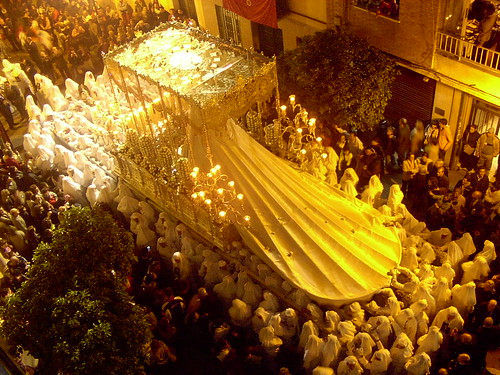 Could possibly describe adequately what it was like Tuesday night. Certainly not how it felt. Soler had asked me about my possible interest in "going into the submarine" in the Virgen del Rocío procession, but as these things don't always work out I remained a little skeptical. Besides, I know what a big deal it is for the men who carry the throne, and I really didn't want to be putting anyone out, even if just for a couple of minutes. So with these reservations in mind, we met in the Plaza de la Merced at 9 and the scene there was already crazy. The idea was that Antonio and I would go into the submarine when Rocío got to Calle Alamos. It looked like that was about an hour away, as the processions were already getting backed up. Clarification: the "submarino" refers to the space directly beneath the throne. Most don't have people in there, but some of the bigger ones do, including Rocío. (See photo, which I believe is taken from Calle Victoria.) So instead of just standing around we (Asun, Daniela and me; Antonio, María del Mar, Fernando, and Agustín Rivera) went to get a bite to eat on one of the side streets off the square. I couldn't eat. I wanted to get going. Finally, around 10:30 we went off in search of Rocío. The procession had moved down Calle Alamos and was at the beginning of Calle Carretería, Rocío's street! Complete madness, you could hardly move, but we managed to eventually squeeze our way through and reached the throne in pretty good time. I thought Antonio would have to get out his cell phone, call, wait, etc., but no, all of a sudden I see him disappear underneath the throne, so I just followed him. Complete darkness and I hear a couple of guys saying to me watch your head, watch your head. Slowly my eyes adjust. But there's no time: cling, cling, goes the bell and everyone's scrambling to take position. So I grab the post I've got next to me, cling!, upphh, lift, and just like that, I can NOT believe this, I'm in the submarine helping to carry THE throne, down THE street. The darkness really distorts my sense of time and space and for the first 30 seconds or so I'm feeling a little nervous, and as a result I can't seem to get in step. This is essential, because there's only a few inches between the guys in front of and behind you. It's really tight. The guy in front of me feels my right foot bang into him a couple of times and I'm certain as soon as we stop he's going to demand that I be thrown out. We move forward a little, cling!, down comes the throne. Rest. The fellow in front of me smiles and welcomes me warmly. A few seconds to say hello, thank everyone profusely for allowing me to be here, but... cling, cling!, Cling! Uppphhhh, lift that throne, steady, sway a little, a few steps back, now forward... beautiful. You can hear the crowd responding. Now I'm focused on the band right behind us and the big drum is marking the beat. Ah ha! Now it's easy, left, always lead with the left I remember Agustín telling me. So with the beat of the drum and watching the feet of the men to my right, I fall into the rhythm. Rest. Alvaro, the guy who seems to be in charge of this group of thirty or so "invisible" hombres de trono, offers encouragement and brief words of advice. Water is offered, and I'm given a handful of little photos of Rocío. Cling, cling... off we go. Someone (Alvaro?) is reciting over the top verses of praise to Rocío. Poetry! The most beautiful.., a drop of divine dew... balm for our tired shoulders... I don't think I've ever experienced anything remotely as absurd, crazy, surreal, and simultaneously wonderful and civilized. I really feel like I'm in a dream, because surely these things don't happen in real life. More encouragement: hold her steady, she's the bride... so smooth not a single candle will go out... And the constant screaming from the street: guapa!, guapa! Ro-ciií-o!! Ro-ciií-o!! Two hundred and forty men to lift this thing. Ten thousand, twenty thousand, it seems like a million people surrounding the throne. It's hot in the submarine and quickly I break into a sweat. And the others in here have already been at it for over three hours. They've got six or seven hours to go! In one stop we move around a little and I go back to the rear right corner where there's a little more room. After a while I sense that we're getting near the Tribuna de los Pobres. This is the famous curve where people have been waiting and waiting, in some cases for hours. And it's here where one of the best saeteros is always positioned, ready to belt out this particular variant of cante jondo, the "deep song". This is where the cheering gets really wild and the throne gets lifted a pulso. Antonio had already asked me if I'd had enough. Are you crazy? As soon as I realized that no one was kicking us out, that in fact there was space for us, I thought, hey, let's keep going all the way to the Tribuna. In the next stop, Alvaro quiets everyone down: pay attention, this is it, this is big... it gets really loud, listen carefully, it will be very hard to hear the bell... I can barely see anything outside the submarine, but I know what it's like. The energy on the street is palpable and the the band is playing as loud as they can, trying to stay audible. We're getting close. "Guapa, guapa, guapa!" Stop. It gets quiet. A saeta. Bone chilling. The saetera is just to our left, above us. She has a beautiful voice. Are we in Morroco?, Arabia? Malaga in the twelth century? Or is it Woodstock? Ayyy, ayyy, ay yaaaay yaaaaayyy..... The timing is perfect. Among the seeming chaos and anarchy someone is thinking of the choreography. A little ways into the saeta, cling!, we lift: Rocío comes to life, the Virgin likes the praise. We gently sway the throne. This is beyond fun! Then, as we move the throne forward, a wailing lament, the reluctant goodbye that has turned my whole being into one big goose bump. Huge, huge applause. We're here. Tribuna de los pobres, the main stage! It's also beyond strange to me, I'm invisible but at the same time I'm quite literally at the very center of the spectacle, right beneath the Virgin, underneath the star. Beautiful! Some of the earlier rests were coming at intervals of less than a minute, but there are no rests here. Ten minutes straight. Maneuver that throne. "Viva la Novia de Málaga! VIVA!!!" There's no space, like parallel parking an eighteen wheeler in an aisle in Fenway Park during a game seven. (And imagining that, if you can, as the whole point of everyone's being there!) But it works, slowly, step left, step left, forward... back.. forward...Uppfff. "¿Qué se le dice a la Virgen? GUAPA!!!" Both arms extended. We lift, from shoulder to finger tips. She's as high as she can go. Delirium! Down. Up again! Greet your audience, take a bow. More lifts. I lost count. Four? Five times? RO-CIII-O!!! RO-CIII-O!!! (Watch this youtube video: http://www.youtube.com/watch?v=G6Q0Ruv2yD4 to get a sense of what it was like. It transmits some of the sense of excitment.) And I cannot believe it. How did I end up here? When I was sixteen I got to play a basketball game in Boston Garden. Huge! This was bigger, much bigger. Ten times huger! Someone wake me up.
4.08.2009
Later Monday
 So I'll start with the surface, the exterior, jotting down here lots of details for the sake of my own memory, because I want to have the details on record. I don't want to forget anything. Some further notes on the rest of Monday: after the early morning session to see the Cautivo, Asun and I did what we could to have some semblance of a normal day back at the apartment. I got a little work done, we had lunch, etc. We took a brief nap. In the evening we went downtown and saw a couple of processions. First we saw the Virgin that accompanies Crucificción go into the cathedral. Nice. Then, thinking that procession was due to make its way across Calle San Agustín after it exited the cathedral, we got a nice table on the terrace at Restaurante Tormes: perfect. Owner Pepe came over to chat and to reassure us that everything on the menu was good to go. But we didn't want a real dinner, just something light. So we have some wonderful ham and a good ensalada malagueña that has a wonderful little detail: some very fresh dill sprinkled on it. What a combination: just the right touch of cod, beautifully cured olives, super fresh slices of orange, the potato... all of which have been lightly blessed with good oil, and then the dill. Olé! Just as we're finishing our salad, here comes the procession. Our own baroque dinner theatre in an unbeatable little corner of Malaga, sitting right in the shadow of the sixteenth century Palacio Buenavista, now home to the Picasso Museum. But wait, the procession is turning left, there they go, down Calle Echegaray. Oh well. So it didn't come right by us, which would have been a lot of fun. We aren't the only ones fooled: Pepe thought they were coming our way and lots of others too–the terrace is packed. But the night is yet young and there are several processions winding their way through the city: next stop, Gitanos, which we see in the Plaza de la Merced: the Cristo de la Columna together with María Santísima de la O. It's interesting to see how the Christ throne takes the long way around the sqaure, the Virgin throne takes the short cut, and that way they can "meet up" at the corner where Picasso's birthplace is. How's that for a estampa malagueña? Each throne involves several hundred people, and the procession as a whole has at least a thousand direct participants. And a good ten thousand people filling the square. Overall a scene of relaxed anarchy with a parade slowly marching through it. And here we get the full effect of the "dolls for grown ups" phenomenon. I just love seeing how the portadores create a sense of theater in the way they "sway" the thrones. First, the operation of getting the thrones to face one another. Quite reminiscent of watching a cruise ship trying to dock. It takes time. OK, now Jesus is facing Mary. The thrones are lifted a pulso, arms fully extended. Well done! Wow! The crowd loves it."Oh my son, are you OK?" "I'll be fine, these Romans have got it in for me, but don't you worry..." Great theater! I'm sure many might take this as a rather blasphemous reading of what's going on, but that's not my intention by any means. There's something about it that reminds me of ballet. There's music, incredible costuming, movement, a simple story line... a collective, complicated effort to produce an effect of great beauty. But at the same time there is the tremendous absurdity of it: what's with hundreds of men, with hundreds more in tow, lugging around a platform that weighs tons (literally) for eight or ten hours? Of course, for Christians who are accustomed to living Holy Week as a time of deep reflection, of quiet meditation on the passion of Jesus, Malaga in general may seem like a place to be completely avoided. Surely no church in its right mind could condone this. (This is not religion, it's idolatry, paganism!) I have a catholic friend who feels this way: this is not catholicism, this is not what we teach! And we have completely secular, non-believer friends who also skip town this week, who find the whole spectacle ridiculous, somewhat abominable, and perhaps even slightly embarrassing. So where are we? That's a question we're not going to be able to answer. It's beyond our scope. I guess you could just call it popular religion, and many do describe it in those terms. In any case, after Gitanos, we walked down to the Alameda to catch a glimpse of the Cautivo. Huge crowds. We caught the very end of another "meeting", this time between two different processions: the Virgin that accompanies Estudiantes greeting El Cautivo as it approached the Alameda from a little side street. A distance greeting. And that was it for us. We were tired and it was almost midnight. El Cautivo would be parading around until five am or so, but that wasn't for us. That was Monday. In the photo, Sentencia, in its traslado, going by the spot on Calle Granada right where Asun and I were enjoying some wonderful food. For the real procession she's on a much, much bigger throne. Restaurante Tormes is on the left and the tables are on the right. (To be continued...)
4.06.2009
Dawn with El Cautivo
 El Cautivo is without a doubt the most popular Christ figure in Malaga. This morning Asun and I got up early to go see the first part of the traslado at 7 am. A traslado is when the processional figures are moved from their "home" church to the casa cofrade where they are set up on their processional thrones. So, it's kind of like a mini-procession in itself. The traslado of the Cautivo has become so popular that the mass that precedes the act has to be offered in the square in front of the church. There were at least four thousand people there this morning at 7 am. (Just as the Christ figure that accompanies Rocío is completely overshadowed by the main act, so too here, the Virgin who accompanies the Cautivo gets very little attention. Anyway, it was worth getting up early to see Jesus and Mary standing in the church doorway as the sun came up. I know it sounds pretty ridiculous, but they really do cut an impressive figure. And the Cautivo has tremendous symbolic significance for so many people here. It transcends religion. After seeing the throne come down the church steps and listening to a couple of saetas, we went off to get some coffee and churros. Antonio, María del Mar and Yeyes were planning on catching up with the traslado, which goes on for several hours, but Asun and I had to get home to walk Waldo. If they catch up to the throne, they'll see that it will have already collected thousands and thousands of red carnations. By the time they're done Jesus and Mary are wading in flowers waist high. We'll have another chance to see them (El Cautivo and la Virgen), along with several other processions, this evening.
4.05.2009
Paella with Rocío
 Yesterday Soler invited Asun and me, along with some other friends, to join him at the annual paella organized by the Rocío cofradía. (The official name: The Royal, Illustrious, and Venerable Sacramental Brotherhood of Our Father Jesus of Nazarus on the Path to Mount Calvary and Most Holy Mary of the Dew Drop.) So, with a little name like that you might imagine an event that's, say, solemn, religious... Far from it. Just hundreds of people having a good time in a school courtyard. At least a dozen huge paellas and an open bar. Some of the paellas were really excellent, especially the first one we were served, which featured artichoke. We had a nice time and were most graciously served by the former "hermano mayor" Antonio Pino. Then the mayor came by to say hello to the Antonios (Soler, Meliveo, Pino) and we got to chat for a few minutes. It's funny, I've met this guy I don't know how many times, but it's always the first time. I understand, he's probably introduced to a few dozen people on a daily basis. In any case, he actually seemed interested to learn about Dickinson and I invited him to come visit. And to bring along a procession! Then, after this big meal, including, just to be consistent, rice pudding for dessert, Antonio Pino walked us up the street to give us the grand tour of Roció's new digs: the huge "casa cofrade" that was just inaugurated last year. Antonio's enthusiasm was quite endearing and he was a wonderful guide. We spent about thirty minutes admiring the thrones and learning all about the little details of the decoration. It's hard to describe, but they are truly amazing. And big! It takes 170 men to lift the Christ throne and 240 to lift Rocío! Kind of like visiting a big fire station, but filled with photos and paintings of Virgin Marys. The building is huge and includes a small auditorium with seating for 300. And, of course, a bar. In short, a clubhouse. And I joined up, so now I'm officially a "brother of Rocío". Of all the cofradías in Málaga, over forty, this is, of course, the only one I could imagine joining. Rocío! La novia de Málaga!
4.03.2009
The Visitor
 Yesterday we went to see the film "The Visitor" by actor/director Tom McCarthy. Excellent. Richard Jenkins, who plays the lead role, is astoundingly good. If you haven't seen this film, go get it on DVD. Early on I had my doubts, as it seemed like maybe the film was going to fall into some liberal clichés about multiculturalism and American guilt. But not at all. There are some interesting twists and wonderful subtleties. The themes are nothing new, but evolve mainly through convincing, understated performances from some wonderful actors: love and friendship are possible. We all screw up. We are all just visiting. Home? Better find someone to love. Tom McCarthy directed and wrote the screenplay. He also directed the wonderful 2003 film "The Station Agent." Another must see.
4.02.2009
With Bipolar Lenses...
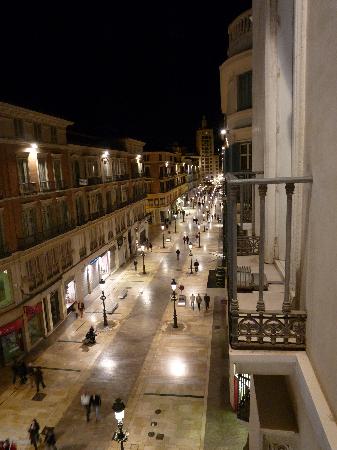

Good day, bad day. Order, chaos. It seems that so much of our contemporary reality is interpreted as a constant back and forth movement. Riding the yo-yo. Stocks are up. No, they're down. The world is falling apart. Wait, things are getting better. Life in Malaga certainly lends itself to this kind of bipolar reading. There's a forward looking lense in which you can see a prosperous, technologically advanced, cosmopolitan, multicultural city. Turn around: what were we thinking? Poverty is everywhere, nothing works, backwardness and provinciality rule supreme. Calle Larios vs. Calle Beatas. The other day, as is often the case, the beach right here out front was really dirty and the Paseo Maritimo a stinking mess. Then the limpieza army sweeps through, the sun comes out and it's back to Paradise. It never lasts long: it just takes a handful of the regular slobs to mess it all up again. It's amazing how groups of beach goers refuse to make even a minimal effort to clean up after themselves. Some days everything works smoothly: you get to the bus stop right before the bus arrives. The driver greets you kindly. You go to the bank and there's barely a line. Then, the next day Malaga presents itself as a paradigm of incivility and disfunction. This week there is frenetic activity to get the city all spruced up for Holy Week. This is Malaga's big show! Too bad it can't be the week before holy week all the time. The Paseo Maritimo has been power washed, the gardeners have come through and cleaned up the flower beds and cut the grass. Our little neighborhood is looking quite splendid right now. Rest assured they don't do it for us. If the city weren't expecting a huge influx of tourists, forget about it. (In the top photo, Calle Larios at night; below, Calle Beatas, in the heart of downtown.)
4.01.2009
Dios mío, Dios mío!!!
 It happened! We won the lottery! La Primitiva! I just found out. Oh my gosh! Thirty six million Euros!!! What in the world do we do with all this money? And here in Spain it's tax free and you get it all at once. Good Lord! I haven't told Asun yet-I'm afraid she might have a heart attack. Can you just park money somewhere these days? I mean, there really isn't much we want to change. I guess we pay all the bills. Maybe a new car when we get back to Carlisle. Pay off the mortage. Fix up a few things. Hire an assistant? That's it– a chauffeur. We'll call him James.
Subscribe to:
Posts (Atom)
