Showing posts with label Religion. Show all posts

7.12.2010

Creative Genius

Just a few minutes ago I was walking down the street with Waldo. I was in poor condition, feeling both physically and mentally down. Rafael Pérez Estrada saved me. Really, that's the power of poetry. I started bringing to mind some of his verses, but, what a luxury!, also recollections of his presence. Now I'm back home, and a jewel of a poem appeared at just the right moment. The poem is "Demasiadas cosas para un solo poema" ("Too many things for a single poem") and it's classic Rafael: our reality is overpopulated with wonder. In this poem the poetic voice is observing nuns and seagulls at the beach. He posits that they'll have to post a sign prohibiting so many nuns and gulls from flying around at the same time! The poem's central metaphor is compelling: "It's as if all the stars in the sky insisted on coming out on the same night." Saved again!

5.27.2010

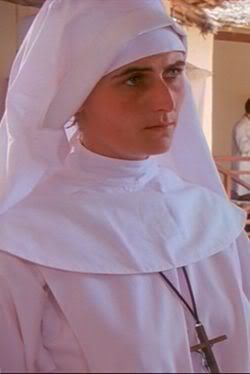
Sister Margaret McBride and Solidarity (or its absence)

This morning Nicholas Kristof writes about the recent and sudden excommuni- cation of a catholic nun in the diocese of Arizona. Why would a nun devoted to caring for others and described by many as "saintly" be excommunicated? It must have been something truly horrid, for, as we know, wayward priests rarely receive this, the ultimate punishment within the church. Priests who fail to keep their vows: not so bad. Priests who question church doctrine: disciplined, but not excommunicated. Pedophile priests: it seems they typically get a job transfer. Those higher ups who tolerate pedophile priests: retirement in Rome. What did the devout nun do? She, as part of a group decision, gave the ok to an abortion that was deemed necessary to save the life of an 11 week-pregnant woman. (The woman is the mother of four children.) Sister Margaret served on the bioethics committee of St. Joseph's hospital in Phoenix and, according to Kristof, the committee's "decision was made after consultation with the patient, her family, her physicians, and in consultation with the Ethics Committee." An abortion is a tragic event, and many believe there are circumstances when it can plainly be viewed as killing an innocent life. But imagine the circumstances faced by the young woman in Phoenix. She is suffering from pulmonary hypertension and her pregnancy may kill her. She can have an abortion and live. Or she can move forward with the pregnancy and risk death, and by extension the death of the fetus her own life is suppossed to be sacrificed for, or, if ( a very big if) the pregnancy is sufficiently advanced and there is lots of luck, perhaps save the life of the fetus, who would then be born orphaned. One can easily see the terrible nature of this ethical dilemma.

If the reporting about this story is accurate, one can safely assume that had St. Joseph's hospital denied the patient abortion services, she would have been quickly transferred to another hospital for the procedure. That's important: once the patient and her physicians had agreed on a course of action, the abortion was going to take place. But in the event, Sister McBride, according to the Arizona Republic, was the Ethics Committee member on call at the time a "last minute, life and death" decision had to be made. She gave the ok to a decision already made by the mother, in consultation with family and physicians. Can anyone possibly blame a woman for wanting to live? A mother of four? Sister Margaret must have understood, must have been thinking about that mother and those children, about life.

When Bishop Thomas Olmsted learned of the case, he immediately excommunicated the nun, "automatically." The automatic nature of this spiritual death is fascinating. (Remember, an excommunicated catholic cannot receive communion and is, thus, to a great degree cut off from God. So, I don't believe calling this a "spiritual death" is overstating the gravity of the punishment.) Most significantly, it suggests that the particular circumstances are irrelevant. That is, even had the doctors been certain that failure to abort would result in the imminent death of mother and fetus, it would still have been cause for excommunication. No discussion, no need for an Ethics Committee. The lack of any openness to nuance, to the particular tragedies of real life are of no interest to the men in black when it comes to core doctrine. And so the church moves boldly backwards, in this case, cutting off a, by all accounts, faithful and "humble servant". Margaret McBride has dedicated her life to serving the sick and poor as a nun of the Sisters of Mercy order. (This is a nineteenth century order founded in Ireland, not to be confused with the Religious Sisters of Mercy, a Vatican II order founded in Alma, Michigan.)

It is astounding. The church hems and haws for years about what to do with the pedophiles among them, knowing that in the meantime these perverts are traumatizing the lives of their victims. Consider the treatment accorded Bernie Law. Awful men getting privilegd treatment by other seemingly awful men. In steps a woman, who, however you feel about abortion, owned up to the circumstances. She acted, according to her own statement to the Bishop, in a good faith effort to follow Catholic doctrine. But no, no discussion: out, out, out. Strange. Where's the solidarity? Why hasn't some priest offered communion to Sister Margaret in defiance of his bishop? Would he too be excommunicated? How many priests would the church be willing to lose over this case? Do they care? Are they willing to put it on the line? That's the question that really interests me: when are the rank and file priests going to put it on the line? They hold the power.
2.20.2010

Paradox

I don’t have faith. I should modify that: I don’t have the faith, not the kind so admirably identified by Clara Beltrán, a young woman from Sevilla who has a big career ahead of her singing cante jondo, the “deep song”. Although I don’t share Clara’s faith, I am moved by it. Seems somewhat paradoxical. And her saeta can move one to tears. Feel that. As she herself says, when she sings to her Christ she tears up. She also says quite emphatically that it's all about feeling, feeling that comes from faith. And then with that single pronoun she identifies something essential about saetas and, I believe, about cante jondo generally: the heart of things, the esential questions, are made real when expresssed in personal, intimate terms. (On the other hand, it’s quite funny how she catches herself when she’s about to utter something about having to sing to Christ figures that don’t mean much to her. But she doesn’t quite say it. She was on the cusp of giving voice to an uncomfortable truth regarding holy week celebrations in Southern Spain: contrary to the logic of Christian dogma, there are intensely held personal preferences regarding the iconography. ¡No te metas con mi Virgen! Count me among the guilty!) Back to the saeta: the suffering is felt intimately. There is nothing superficial about it. The voice, the gestures, and above all, the centrality of the setting, propitiate the comunication of intensely felt emotions. Pain so horrible it threatens our very existence. Love so immense it can redeem all. Is any of this real? She can be seen and listened to on this youtube video. Anyway, I came across this video in the context of my composition course, in which we listened to a few of the songs from Miles Davis’ Sketches of Spain. One of the songs is titled Saeta, and I wanted to give them some context, so that’s where Clara comes in. The point of listening to Miles was to talk about cultural borrowings. We didn’t get far in that conversation, but we’ll come back to it. (Above, "La chiquita piconera" by Julio Romero de Torres.)

9.05.2009

Atahualpa Severino

The Senators played their last game of the year on City Island Thursday, a beautiful, moonlit evening. There was a big crowd, but fortunately, over half of them left by the end of the sixth inning. I'm not against crowds, but I guess "intolerant" would not be an inaccurate description of my attitude regarding groups who display blaring ignorance regarding the behavior that is expected of them so as not to impinge on my enjoyment. Hah! It seemed that crowd had it all backwards from the start. As it was the last game of the year, and the last game in the stadium's current incarnation, there were some pregame ceremonies, words from the mayor (STILL Stephen Reed, after all these years, BUT, he has been perhaps the greatest mayor in the history of Harrisburg), etc. So for the national anthem a Knights of Columbus 4th degree honor guard decked out in their silly garb with the big chapeaus marched out to the field. Very serious. They brought along the Vatican flag, crucifix included. Everyone gets all pious. Ok, ok, patience... then the game starts and no one pays attention. It's as if six thousand people had just paid five or ten bucks a head for the privilege of paying more money for greasy funnel cakes, awful hot dogs, and frozen pizza while they enthusiastically obey the commands of a big screen telling them to make noise on cue. Well, why the hell don't they go to an amusement park instead and let me enjoy the ball game! The game, now that's sacred. You want proof that not everyone is on the same page as me? Imagine this: towards the end of the game I was standing behind the box seats along the third baseline. A guy come up and stands next to me. We chat a little, nice evening, nice catch, etc. Then he turns to me and says, "Have you tried Jesus?" I choked on my coffee. He had this beatific smile, as if really expecting I was going to fall down to my knees and give eternal thanks for having been finally saved. Doing my best to suppress laughter, I explained that I really wanted to focus on the game. Then I left. But the game: as Manolo says about the bull fights, there's always something interesting to see, regardless of how mundane or otherwise disappointing the proceedings. And Thursday night no doubt I found interest in watching Atahaulpa Severino. This guy looked very good. He's only 5'9'', but he brings some serious heat. I think you'll be seeing him in a major league uniform before the end of the 2010 season. He's clearly on an upward trajectory, unlike the larger part of this group of Senators. It was a long game and I was sorry to see it end. And, by the way, it ended with the Senator's scoring a run with two outs in the bottom of the ninth to break a 3-3 tie.

5.27.2009

Antequera, Again

Yesterday we took Danny and Mark Steele to Antequera and had a really fine visit. We started with the megaliths, then lunch at El Angelote, where I had truly one of the most outstanding steaks I've ever eaten. Had I known it was going to be so incredible I wouldn't have ordered it because post-consumption I had to deal with the guilt. But forgiveness is always but a step away: after lunch is was the ecclesiastical tour -- the church of Carmen, the Teressian convent, and the church of St. Sebastian. Finally, on the way home we stopped at El Torcal and had a beautiful hike. The church of Carmen is always amazing, but what most got my attention on this trip were the little porcelain baby Jesus's in the museum of the Teressian convent. They are mainly 17th and 18th century figures, with a few from the 19th century. It's quite strange how the artists depicted Jesus in so many different "poses" and how the nuns dressed him up in all kind of manner. (Just like Barbie and Ken - an outfit for every occasion!) One of my favorites was Priest Jesus, depicted consecrating the host. Hey, the little kid is about to eat himself! Crybaby Jesus was also interesting (a tad more understandable, no?), and Sleepyhead Jesus was one I could definitely identify with. And I saw an image I'd never seen before: the Virgin represented as a little baby! And another: a painting of "Our Lady of the Book"! Now there's a good vocation, assuming, of course, we mean books in general. All these strange representations got me thinking about the strong emphasis here in Southern Spain on the most human aspects of their religion. The Counterreformation was no doubt for the most part a thoroughly awful undertaking that created unspeakable suffering for people around the world, but if there's a sliver of light to be found, apart from its superlative artistic legacy, perhaps it is in the peculiar transformation of religion that took place, in my view, in Southern Spain: the biography of Jesus becomes an elaborate drama designed to generate empathy and identification, and the importance of belief in "the one God" seems to dissipate. Belief becomes belief in ourselves. Humanism ends up winning anyway.
Our hike through the Torcal was quite memorable. We spotted several mountain goats high up on the strange rocks, and also saw two foxes (plural of fox? One fox, two fox; one fox, two foxes?) one of which was quite large. In the phot0, a carefree kid on the edge of a cliff.

4.26.2009

"Salutat vos... Marcus, filius meus"


Yesterday was the Feast of St. Mark, so in honor of my namesake I spent a few minutes trying to find out a little bit about him. It's not easy: the historical record is quite sketchy. Some of this is probably true: he is commonly understood to be the John Mark of Acts and his mother was Mary (not the Mary) and she had some meetings of the first Christians in her house in Jerusalem. He may have been a cousin or nephew of Barnabus. Paul thought he was unreliable (Sounds familiar!), but later changed his opinion, coming to view him as quite dependable. He is believed to have been responsible for bringing Christianity to Alexandria, where he was martyred, tied to a horse and dragged around the streets until he was dead. (I really want to visit Alexandria some day, and hopefully I will be able to do so without being tied to any horses.) He is symbolized with the lion because his gospel, the earliest, starts with the cry of John the Baptist from the wilderness. Ok, now the cool stuff: in the ninth century two Venetian merchants retrieved Mark's remains from Alexandria and safeguarded the operation from overly curious Muslims by wrapping the remains in pork! Ah ha, no wonder I've always loved ham! Strangely, according to tradition, those inventive but incompetent merchants forgot Mark's head! Many centuries later, the head got lost (Sounds familiar again!), but eventually it turned up in Rome. (How convenient!) In 1968 Pope Paul VI gave Coptic Christians part of Mark's head back (!!!), and they joyfully celebrate its return to Alexandria every year on November 10th!! I think, the story gets complicated here. (See photo.) Now there's a pilgrimage I'd like to make! And how about this other image, above. I haven't been able to find out anything yet about its authorship, but I like the lighthouse in the background. Kind of like me right here, walking by the Farola. Go Marksie! And according to the website "Orthodox America" (watch out!), after being tortured for a day by the evil pagans, Mark was visited first by an angel, then by Jesus himself. Cool! (I can relate, kind of: back in college I did have a psychedelic hallucination once, and it involved a lion! This is true, but it's another story.) Poor Mark, I bet torture could make just about anyone hallucinate. Now, my only question is, given that Mark died from being dragged around behind a horse, I doubt he was in any condition to share his experiences. He sure didn't have a chance to write about them. From what I gather looking at European painting, bishops in medieval times were very prone to visions and other celestial visits during which they were told all kinds of things related to early church history. So, you can't just make it up; at the least, you've got to have a dream. I don't know why, but I've read that if you're having relationship difficulties, pray to St. Mark. And why do I not get as much work done as I should? Because I haven't been praying to Mark's head!
     Finally, speaking of dreams, we'll call this Dream Sequence #43: It's the top of the 36th inning at Fenway Park. The Red Sox lead the Yankess 8 to 5. The bases are loaded and Alex Rodriguez is at the plate. Two outs, full count. The sun is rising as a deep fog begins to lift. At the top of the inning almost no one had noticed a historic substitution: a young woman just called up from who knows where, Rocío De Málaga, jogged out to left field. Those fans who aren't asleep think it's a stunt, a notion reinforced by the fact that instead of cleats, her dainty feet are wrapped in a pair of red hightop Chucky Taylors. What is this girl thinking! Let's get serious! And what's this, her jersey isn't tucked in and it's way too big in the back. Looks like a wedding dress with a long train. Nonetheless, this is The First Female to ever play in a major league game! Timmy Wakefield is on the mound, mug of coffee at his feet. The knuckler doesn't knuckle and there goes an incredible drive to left, a real rocket headed over the wall. But wait, Rocío takes a few steps back, turns, jumps, up, up, up, oh goodness, she keeps going up and snags the drive just as it's set to land in the top row of the monster seats. Yowzer! The fans holler, Ro-ciii-o, Ro-ciii-o! Sox have held on for a big, big win. In the clubhouse after the game, asked about the Chucky Ts, Rocío told reporters she had a hunch she might have to jump.

2.06.2009

Natural declines

Yesterday Cardenal Tarcisio Bertone, the Vatican's Secretary of State, was in Spain to meet with Zapatero. He also gave a talk on human rights in which he defended the necessity of respecting an individual's dignity from conception to its "ocaso natural", its "natural decline". ("Ocaso" literally refers to the setting of the sun.) That's a principle I can certainly defend. What I don't understand is why the catholic church in Italy has gotten so incredibly worked up over the case of Eluana Englaro, the woman who has been in a persistent vegetative state for seventeen years. Is it natural to keep an individual alive in these conditions year after year with a feeding tube? What ethical purpose does that serve? The church is against euthanasia because you risk having humans "play God". That's a good argument. But it works both ways-keeping someone alive indefinitely when there is no rational hope for recovery is certainly not natural. And it's a perversion of the medical profession's obligation to preserve life. Is Elena Englaro living with dignity? Her father doesn't think so: he's been fighting for ten years for the right to get the tubes disconnected. Who do you trust, a loving father or a bunch of fanatics screaming "Elena, wake up, wake up"? Anyway, that's what I've been thinking about this morning.
Last night I got to see Jesús Aguado for the first time in many months. He was here to give a talk on the work of printer Francisco Cumpián. I also ran into Juan Temboury, who's phone # I'd been fruitlessly searching for. It was great to see them and Jesús's talk was good. (In the photo, the beach at Matalascañas.)

1.09.2009

The Holidays are Really Over Now


Yesterday Cristina and I went to Antequera to do a little tourism. It was a cold day but we had fun. This was my second visit to the Church of Carmen since its restoration and I found it just as amazing to see as the last time. Always new details to admire. The photo above is a little detail from the pulpit. After that taxing visit we went into the Poor Clare's convent to get some of their baked goods ("Ave Maria Purisima" I greeted the nun hidden behind the "lazy Suzan". "Sin Pecado Concebida" she responded. Then we could get down to business.) After a quick cup of coffee at a nice little bar, we visited the city museum and were fortunate enough to have a great guide. She pointed out several details I had missed in earlier visits, including a chasuble that was created in the early fifteenth century from a flag of the Moorish kingdom of Granada. Incredible! There is lots of other liturgical paraphernalia and art that I find fascinating, including a 16th century life-sized sculpture of St. Francis carved from a single piece of pine by Pedro de Mena. And lots of other amazing "stuff". Our visit had begun with the megaliths just outside town and in the one with the deep well at the center, a "modern" work, I couldn't resist contributing a little of my spit to the pool at the bottom. Plip! And I couldn't help being reminded of Basho's famous frog haiku, which for some reason I had come across a few days ago in an essay. Here's Allen Ginsberg's translation: The old pond / A frong jumped in / Kerplunk! On our way out of Anequera I slammed on the brakes when I saw that the church of Santiago had its door open. Fortunately there was just a little space to leave the car on the side of the narrow street. I had never been inside and didn't want to miss this opportunity, as it seems to usually be locked up. Cristina stayed in the car and I told her I'd be just a minute and to come get me if there were a problem with the car. There was just one elderly lady in the church. She was sitting in the back pew, praying. I wandered up towards the main altar, which was presided over not by Jesus or Santiago, but my a huge Virgin, in this case Our Lady of Good Health (La Virgen de la Salud). I was just standing there when the old woman startled me by tapping my lower back. She was about four feet tall and looked to be well into her eighties, if not nineties. She asked me where I was from, then took me by the hand and started to lead me right up to the altar. For a moment I feared she thought I was a heathen and she was going to make me get down on my knees and repent. But no, she got out some keys, unlocked a little door hidden in the wall and pushed me up a tiny staircase which led me up behind the main altar to where the Virgin stands under an unbelievably densely decorated baroque cupola, her chamber. Fun! Then my octogenarian friend asked me if I might like to have an image of Our Lady. Would I! So she brought me into the Sacristy and got me a little photo which is now in my wallet. Then she got out the collection basket and suggested I might like to put something in it for the upkeep of the church. Not a problem. Apparently satisfied with my modest contribution, she took my hand again and led me over to a little side chapel dedicated to Our Lady of Work. (La Virgen del Trabajo, not a common devotion! Damn, it was if I were nine years old again, opening up a pack of baseball cards and lo and behold there's Mickey Mantle!) In this chapel she pointed out an old baptismal font in which the year 1611 was clearly carved into the white marble. Cristina could hardly believe her eyes when she saw the old lady accompany me out the church; she wanted to point me in the direction of the next church I should visit. But I spared Cristina, as it would have been ecclesiastical overload for her. On the way home we stopped and had lunch at a local classic: Venta El Tunel. I write this having just returned from taking Cristina to the airport. Now it's just Waldo and me.

7.17.2008

The Feast of Carmen

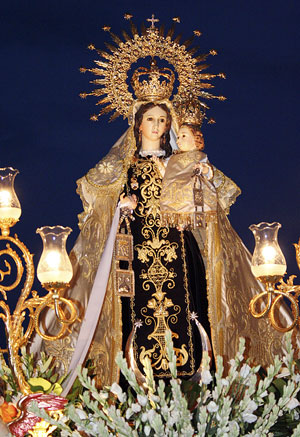
Last night Carmen had her big day. July 16th, the Feast of the Virgen del Carmen, patron saint of fishermen and sailors. There were friends here at the apartment and we could see the fireworks going off up and down the coast. There are a couple of processions this weekend. Bob Massa and his friend Ellen are visiting and so far seem to be having a fine time. Yesterday I showed them the Cathedral and the church of St. Lazarus, where Rocío is housed. Then we had a nice lunch on the beach out in El Palo. Today we will probably drive out to Nerja and Frigiliana. The name Carmen comes from Mt. Carmel, in present day Israel, where a Marian apparition gave birth to the Carmelite order. The cult to this image came to Spain in the 13th century and over time has grown greatly in popularity.  In Málaga there is a great image of her in the Church of the Holy Martyrs, downtown.