1.26.2009

Birth by Chance

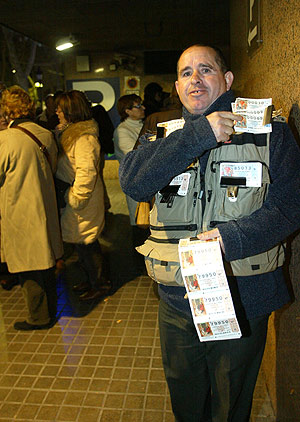
Yesterday I was catching up with José Angel Cilleruelo's blog and came across one of his funny little dialogues. I don't know if this is pure invention, but I doubt it; I can imagine this happening pretty much the way he presents it. He presents it under the category "little theatre works." The conversation is between a lottery seller and client, which is immediately obvious for a reader of the original, but not necessarily so for one unfamiliar with Spanish life. Something about it caught my fancy so I went ahead and translated it:
–Please, could you give me a number that ends in 85.
–Does it have to be 85?
–Yes, it's got to end in 85.
–85, let's see what I can find. Here's one in 58 that smells like a winner. Will it do?
–How funny. I was born that year. In 58.
–A good reason.
–I'd prefer one that ends in 85.
–That means your reason is better.
–Well, perhaps.
–A reason better than having been born? Could there be one?
–I don't think so, none.
–So? 58?
–So: 85!
–Better than being born?
–To be born again.
–Another time?
–Not another time, the first time.
–Now I get it! But in 85... Nothing!

And speaking of birth, how about that woman in California and her eight newborns! That's hitting the lottery! I'm hoping not to be unborn today. Have a little trip to Cordoba to see Pablo today; should be fun.

Architecture

Not long ago I made a brief mention of Paco Ruiz Noguera's most recent poetry collection, Arquitectura efímera. A few weeks ago Soler reviewed the book in his weekly article for Sur. I missed it then, but he mentioned it last night and so I just read it. Excellent. In these articles Antonio is masterful at capturing the essence of things in very short order. And in just two sentences he gets at the core of Paco's character, recalling, on the one hand, that Rafael called him "Paquito", and on the other observing that he was probably the most sensible person among the Bilmore group. True! Here's an improvised try at some of the book's initial verses, from a short poem titled "Purpose": "Hold on to life / as in empty days / you hold with your gaze / a touch of blue / shining through the mist." The varied rituals of holding on are often lived with desengaño, disillusion, and even touches of bitterness. Sometimes it's all we can do, just hold on. And share it. The horizon is silent and uninterested in us. And there is tedium. The signs are dark. We build what we can, ephemerally.

1.25.2009

El Acebuchal


Yesterday Asun and I went up to the Acebuchal, a fascinating place in the mountains behind Frigiliana. We were joined by Fernando, Antonio, María del Mar, Chris and Rosalynd. After the Spanish Civil War there were some small groups of guerilla fighters who tried to keep the cause going. They hid out in rural mountainous areas around Spain. The tiny, isolated village of El Acebuchal, really just a tight cluster of eight or ten very modest homes, was shuttered by the Civil Guard shortly after the war. They feared that the village was too sympathetic to the Maquis, as the rebel holdouts were known, and that it was too isolated for them to control. And so for decades the Acebuchal was a ghost town that fell into complete decay. Then in 1998 the children and grandchildren of one of the families that had to abandon the place began to rebuild. And it kept going. Apparently they have been quite faithful to the way things were before the war in their restoration efforts. I believe five or six families live their full time now. The result is quite charming. There is one little restaurant and that, of course, was our destination. Lunch was superb: salad, lamb in mint sauce, goat in almond sauce, and wild boar. Coconut cake for dessert. 

1.23.2009

Down the Coast


The other night I was talking to Pedro Martín-Almendro about the unfortunate relationship between the cultural life of the capital and the international population of "foreigners" up and down the coast. There seems to be a lot of mutual looking away. The Costa del Sol is certainly an interesting habitat. Known, obviously, for its sunny climate, it is in reality an immensely complex area that seems to be defined by a few persistent stereotypical images. One of the realities of the coast is the presence of organized crime, usually described as "mafias". The mafia mafia has a presence, but over the course of the past ten or fifteen years the arrival of criminal groups from Eastern Europe has accelerated. Just a brief sampling of the crazy mix of stock figures we imagine here: young Brits in for a weekend of obnoxious drunkenness, tourists from anywhere in Europe looking for a little sun, Spaniards in search of a cheap getaway, Arab elites looking for Western decadence, Russian mobsters, third rate glamour people, Bulgarian hitmen, etc. Major professions: real estate developer, corrupt politician, jeweler, prostitute, drug dealer, paparazzi... In any case, this morning two stories from the coast, one kooky and the other tragic. The tragic: some soulless hacks kidnapped a local businessman and held him briefly for a million euro ransom. For whatever reason, they didn't wait long and this morning his body was found along the side of the highway. A brutal, cold-blooded murder. I read about the poor victim and his story and tragic end provide several metaphors for the recent history of this area. But that's another story. The kooky: a frenchman was arrested yesterday for trying to organize an exhibition of works by Dali in a hotel in Fuengirola, an ugly coastal town between here and Marbella. Yes, a hotel in Fuengirola is a likely place for a serious art exhibit. And of course it's pefectly normal for the works to be thrown into a truck sent here from France. And naturally you'd store over sixty Dali originals in one of the hotel's rooms with no special security. Right. And exactly who did this guy think was going to buy these valuable pieces of art? Dali is one of the most forged artists in the world. I guess the guy figured he'd find plenty of suckers here who wanted to launder some money. And probably a very reasonable supposition. (In the photo, Fuengirola's main beach.)

1.22.2009

Funny and Not so Funny

On Tuesday two workers found themselves trapped in an apartment. They got out onto a terrace and after a time were able to flag down a policeman, screaming that they had been taken hostage. They had just finished some work for the owner of the apartment and had been paid 1300 euros. When the woman demanded they sign a receipt they refused. So she locked them in the apartment and left. And this illustrates a basic difference between American and Spanish homes that has always struck me: here door locks are of the dead bolt type and they don't have a release from inside. So if someone locks the door on their way out and you get left behind without the key you're stuck. This has always seemed to me a horrible safety hazard, but that's the way it is. Funny story. The woman was arrested for kidnapping but the workers had to return their fee. So everyone lost. Less funny is a story in El País about problems with the vandalization of public art in Spain. The story begins by pointing out that at a youth hostal in Amsterdam there is a sign requesting that public spaces be respected. It's only in Spanish! How sad. The article goes on to report of several cases of public art around Spain being destroyed almost as soon as it goes on display. Just last week I was showing a few of my students the beautiful bronze sculpture that pays homage to Rafael Pérez Estrada. As I got close to the statue I suddenly started to feel sick to my stomach, and also enraged. Graffiti all over it. I just wanted to cry. There is no doubt that the sense of shared civil responsibility is weak in most parts of Spain. Spaniards keep their homes spic and span, but not their public squares. And the problem is not that no one is cleaning up. Malaga has a veritable army of street cleaners. Which is why streets and squares here can be absolutely gorgeous in the morning and a look a little rough around the edges by mid afternoon. I'm reminded of Rosa Montero's fine article in the Sunday magazine a couple of weeks ago in which she reflects on the very basic importance of beauty in our lives. Beauty as a civilizing, "taming" energy. Not a new idea, but she expresses it well in her article. I don't think you can meaningfully live without rather regular exposure to beauty. In the photo, a sculpture in downtown Bilbao.

1.21.2009

Envy

Two news items this morning remind me that while in most ways people are the same everywhere, culture certainly plays a vital role in shaping how we interact with one another. For the past few days El País has been reporting on a shady investigative unit created by a Madrid councilman. They describe it as basically a publicly funded private detective agency used exclusively by the councilman to spy on his political enemies. With no accountability. And this morning some good quotes from Nacho Duato, the director of the National Dance Company, regarding his anything but amicable departure. In both cases the degree to which energy is directed towards very personal rivalries is quite striking. Rosa Maria Artal observes in her recent book España, ombligo del mundo, echoing generations of earlier writers, that Spaniards are plagued by envy. It seems that anyone's success must be at the collective expense of everyone else. It seems to be the national sin. There have been many comments along these lines, for example, regarding the famous chef Adriá Ferrán. It's my impression that historically Spanish society has prized individual genius over the more mundane accomplishments of collective effort. The grandeur of the gesto. And during the empire, Spanish might was often portrayed through the image of a personified nation of unique brilliance, in turn exemplified by a small number of heroic figures: El Cid, Columbus, etc. All countries have done this, of course, but in the case of Spain the emphasis on individual exceptionality seems particularly strong. And as the catholic church has taught generations of Spaniards, sainthood is reserved for a very select few, even though all should aspire to it. This persistent envy then gets translated to institutional rivalries as well. Now Malaga and Seville are fighting over which city will host the central offices of the hoped for megabank created by the merger of several Andalusian Savings and Loans, the Cajas de Ahorro: Unicaja, Cajasur, Caja Granada, etc. And Malaga fights with Cordoba over which city should be designated European Capital of Culture for 2016. In fact, last night with Pedro Martín-Almendro of the Fundación Málagaa, I attended a talk by Neil Peterson, who led the Liverpool Culture Company, the organization that got that city the cultural capital designation for 2008. Based on the attendance I wouldn't feel too excited about Malaga's chances. And I'm sure some people in the Madrid metro felt envious of Asun and me when they spotted us with our three beautiful daughters. Who could blame them? Just joking. After all, Obama did speak yesterday of the importance of humility. I hope we were listening!

1.20.2009

Inauguration Day


It's inauguration day and here, too, it's getting a tremendous amount of attention. Yesterday a woman from SER, the big radio network, called me to ask if we could talk this morning on air. Hopefully we'll be able to get a tv set up at the Cursos so that the students can see some of the ceremonies. Classes started yesterday and there's a whole lot to do this week. Calma...  In the photo (taken by Daniela back in November) a scupture by Baltazar Lobo displayed on the Paseo del Prado in Madrid. These sculptures are now on Calle Larios in Malaga, where last year we had sculptures by Rodin. 

1.14.2009

Recent Readings and Travels


It would be nice if I had more time to comment on some of my recent reading. Over the Christmas holidays, in addition to the Richard Price novel Bloodbrothers, I read Gabriel García Márquez's short novel, Memoria de mis putas tristes. (It was translated to English by Edith Grossman with the title Memories of my melancholy whores.) Garcia Marquez writes beautifully, but the story didn't say much to me. An old man who has just turned ninety decides he wants a virgin before he dies, so his old friend the local madame sets him up with a fourteen year old girl. His initial desire is thwarted but he ends up falling in love with the girl. I've also been reading Luis Garcia Montero's most recent essay, Inquietudes bárbaras, and Paco Ruiz Noguera's just published collection of poems, Arquitectura efímera. Paco's book has been a real pleasant surprise. There is a definite change in tone and style with his earlier work; the language is simpler, more direct. I owe him a note. Bloodbrothers was good, the first novel I had read by Richard Price. It's rigid determinism reminded me of Zola. The Garcia Montero essay is rather frustrating, heavy on argumentation, but sparse with examples that might give some weight to his line of thought. Maybe I'll come back to that another day, but right now I want to jot down a few notes on yesterday's little excursion to Comares, a very small village up in the Axarquia, the eastern most part of the province that includes some coastal towns and mountain villages that are at altitudes of over 3,000 feet in spite of their very close proximity to the sea. Yesterday Comares was de fiesta, celebrating their patron saint, St. Hilarion of Poitiers. Odd for this little village to have a fourth century French bishop as their main man, and I don't know how that came to be. In any case, our little group was welcomed by the mayor himself and his wife just before the mass that would be followed by the procession of Hilarion down to the square and then back to the church. I hadn't been in a church for a service in a long time and I guess I was reminded why: the priest very earnestly explained to the faithful that our current economic mess was completely due to the fact that we had turned away from God. Oh well, people didn't seem bothered, they were just waiting for the procession. So Hilario was marched down the very narrow street to the plaza where the ten or twelve men carrying the throne were served beer by... the mayor himself. (This guy was everywhere, and with his amazing toupée was easy to spot!) Then it was back to the church for the saint. And an open bar for the two thousand or so people in attendance. Yes, it was all on the house, or should I say, on town hall. All the beer and wine you could want. At 4 pm the soft drinks and water were all gone, but the beer and wine was still flowing. And there was plenty of free food, too: chorizo (served by, yes... the mayor himself!), blood sausage, wonderful olives, and, of course, paella for everyone! The serving of all this food and drink was appropriately chaotic, but the students who were stoic enough to wait in line very kindly brought me a plate of paella. And it was actually quite good. And of course, music: two or three pandas de verdiales, a good banda de charangas, and finally the "orquesta", consisting of a female vocalist and two men with those computerized keyboards that produce whatever you want, in this case, mainly a very heavy bass thumpa, thumpa, thumpa. I'm not exactly sure why, but I had this sensation that the leader of the group was on a weekend furlough from the provincial prison. Then shortly before five pm we had a truly esperpéntico moment: the band was ordered to stop the music. A funeral procession. Right through the square they marched, even breaking the line of the people still waiting for paella. The lack of solemnity, of respect for that family's drama, was, for me, observing from a distance, while not surprising, nonetheless rather stunning. Well, it was a beautiful, sunny day and I'm sure a memorable experience for the five students who joined us.
1.12.2009

Cold


Yesterday my new students arrived, so now it really is back to work. Also yesterday, in Madrid, there was a huge demonstration against Israel's invasion of Gaza. The organizers claimed a turnout of 250,000 people. El País estimated 55,000. Some things never change. I sympathize with the indignation expressed by the protesters, but in the news reports I saw not a single speaker made any reference to Hamas's missile attacks. A little one-sided. Also one-sided: I read a few minutes ago in the Times that Al Jazeera English TV is available almost nowhere in the United States. (I see it here and it's good; it's not a bunch of raving radicals.) That's just ridiculous. Think about all the crap your cable lineup is full of. And no one can find a spot for Al Jazeera? That's censorship. And Congress voting overwhelmingly to support Israel's invasion? We have really lost our minds. Read the resolution passed by the Senate. Talking about one-sided! 
But enough of horrible, depressing news. On Saturday a bunch of us went up into the Montes de Málaga to have lunch at the La Nada, the same place we went around this time last year. The usual suspects. It was cold! But the fire in the chimney kept us warm. (Photos, above.) Afterwards we had coffee with Ana Salinas, who excitedly told us that she had just been offered a position with the Council of Europe in Strasbourg. Good for her! Now I'd like to write about recent readings, but there's no time for that at this moment. It will have to wait. Off to work...

1.09.2009

The Holidays are Really Over Now


Yesterday Cristina and I went to Antequera to do a little tourism. It was a cold day but we had fun. This was my second visit to the Church of Carmen since its restoration and I found it just as amazing to see as the last time. Always new details to admire. The photo above is a little detail from the pulpit. After that taxing visit we went into the Poor Clare's convent to get some of their baked goods ("Ave Maria Purisima" I greeted the nun hidden behind the "lazy Suzan". "Sin Pecado Concebida" she responded. Then we could get down to business.) After a quick cup of coffee at a nice little bar, we visited the city museum and were fortunate enough to have a great guide. She pointed out several details I had missed in earlier visits, including a chasuble that was created in the early fifteenth century from a flag of the Moorish kingdom of Granada. Incredible! There is lots of other liturgical paraphernalia and art that I find fascinating, including a 16th century life-sized sculpture of St. Francis carved from a single piece of pine by Pedro de Mena. And lots of other amazing "stuff". Our visit had begun with the megaliths just outside town and in the one with the deep well at the center, a "modern" work, I couldn't resist contributing a little of my spit to the pool at the bottom. Plip! And I couldn't help being reminded of Basho's famous frog haiku, which for some reason I had come across a few days ago in an essay. Here's Allen Ginsberg's translation: The old pond / A frong jumped in / Kerplunk! On our way out of Anequera I slammed on the brakes when I saw that the church of Santiago had its door open. Fortunately there was just a little space to leave the car on the side of the narrow street. I had never been inside and didn't want to miss this opportunity, as it seems to usually be locked up. Cristina stayed in the car and I told her I'd be just a minute and to come get me if there were a problem with the car. There was just one elderly lady in the church. She was sitting in the back pew, praying. I wandered up towards the main altar, which was presided over not by Jesus or Santiago, but my a huge Virgin, in this case Our Lady of Good Health (La Virgen de la Salud). I was just standing there when the old woman startled me by tapping my lower back. She was about four feet tall and looked to be well into her eighties, if not nineties. She asked me where I was from, then took me by the hand and started to lead me right up to the altar. For a moment I feared she thought I was a heathen and she was going to make me get down on my knees and repent. But no, she got out some keys, unlocked a little door hidden in the wall and pushed me up a tiny staircase which led me up behind the main altar to where the Virgin stands under an unbelievably densely decorated baroque cupola, her chamber. Fun! Then my octogenarian friend asked me if I might like to have an image of Our Lady. Would I! So she brought me into the Sacristy and got me a little photo which is now in my wallet. Then she got out the collection basket and suggested I might like to put something in it for the upkeep of the church. Not a problem. Apparently satisfied with my modest contribution, she took my hand again and led me over to a little side chapel dedicated to Our Lady of Work. (La Virgen del Trabajo, not a common devotion! Damn, it was if I were nine years old again, opening up a pack of baseball cards and lo and behold there's Mickey Mantle!) In this chapel she pointed out an old baptismal font in which the year 1611 was clearly carved into the white marble. Cristina could hardly believe her eyes when she saw the old lady accompany me out the church; she wanted to point me in the direction of the next church I should visit. But I spared Cristina, as it would have been ecclesiastical overload for her. On the way home we stopped and had lunch at a local classic: Venta El Tunel. I write this having just returned from taking Cristina to the airport. Now it's just Waldo and me.